
Summary
This chapter gives an overview of the invention of printing and some of the early social and political impacts that followed it, from the 1450s to the early 1800s.

EPIGRAPH
“This is a printing office; crossroads of civilization, refuge of all the arts against the ravages of time, armory of fearless truth against whispering rumor, incessant trumpet of trade. From this place words may fly abroad, not to vary with the writer’s hand, nor to perish on the waves of sound, but fixed in time, verified by proof. Friend, you stand on sacred ground. This a printing office.” — Beatrice L. Warde, British graphic artist & historian, 1953.
SECTION I & Chapter I Outline
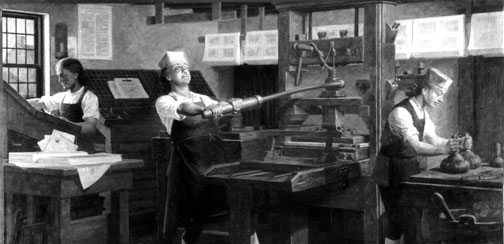
A young Benjamin Franklin is depicting working in a British printing establishment during his apprenticeship. (Charles E. Mills, Library of Congress).
People, events, and themes
Printing revolution: Johann Gutenberg, Jan Hus, Martin Luther, “Bloody” Queen Mary I of England, Sebastian Castellio, Martin Waldseemuller, William Caxton, Geoffrey Chaucer, Georges Agricola, Tycho Brahe,
The Enlightenment: John Milton, Thomas Jefferson, John Locke, Jean Jacques Rousseau, David Hume, Baron de Montesquieu, Francois Voltaire, Diderot, Benjamin Franklin.
Early newspapers: Johann Carolus, Benjamin Harris, John Peter Zenger, Benjamin Franklin, Thomas Paine, Cato (John Trenchard and Thomas Gordon), Camille Desmoulins, Hezekiah Niles, John Walter, William Cobbett
Themes: Moveable type, type metal, incunabula, printing in China
Extended Content
- Chapter 1: Life in the old print shop.
- Chapter 1 Further Reading
- Chapter 1 Videos and podcasts
Discussion questions
What’s a newspaper for? According to Benjamin Franklin, it’s moral instruction. See if you agree with this idea from Franklin’s Autobiography.
In the conduct of my newspaper, I carefully excluded all libelling and personal abuse, which is of late years become so disgraceful to our country. Whenever I was solicited to insert anything of that kind, and the writers pleaded, as they generally did, the liberty of the press, and that a newspaper was like a stage-coach, in which any one who would pay had a right to a place, my answer was, that I would print the piece separately if desired, and the author might have as many copies as he pleased to distribute himself, but that I would not take upon me to spread his detraction; and that, having contracted with my subscribers to furnish them with what might be either useful or entertaining, I could not fill their papers with private altercation, in which they had no concern, without doing them manifest injustice. Now, many of our printers make no scruple of gratifying the malice of individuals by false accusations of the fairest characters among ourselves, augmenting animosity even to the producing of duels; and are, moreover, so indiscreet as to print scurrilous reflections on the government of neighboring states, and even on the conduct of our best national allies, which may be attended with the most pernicious consequences. These things I mention as a caution to young printers, and that they may be encouraged not to pollute their presses and disgrace their profession by such infamous practices, but refuse steadily, as they may see by my example that such a course of conduct will not, on the whole, be injurious to their interests.
- Monk power: How many monks and scribes were replaced by Gutenberg’s printing press? What was the “monk power” of an early printing press? How much “monk power” is under the hood of your laptop?
- Unintended consequences for media ecosystems: What happens when disruptive new technologies emerge, and what can we learn from the interaction of the Protestant reformation and the printing revolution? Paul A. Soukup argues from a Catholic perspective that the media ecology of printing presented four challenges: expansion of discourse beyond the norms; alteration of the equilibrium of the media ecology; new types of rhetoric; and challenges to authority.
- Participation: How have people contributed to and participated in various kinds of mass media? In Chapter 1 we see that mapmakers and scientific publishers were asking readers for corrections and contributions to future editions (p. 26) The first US newspaper, published by Benjamin Harris (p. 32), had 3 pages of news, had a fourth blank page for people to add their own notes as the newspaper was passed around. These are examples of participatory media. How do people participate in media today? Check the book’s index for hints about other participatory media in history.
- Defending Zenger: Suppose you had to represent someone accused of seditious libel. How would you defend someone like John Peter Zenger today? How would you describe the idea of “natural rights” today?
- First Amendment: Why is religious freedom the first item in the First Amendment? How does that relate to the historical issues from this time?
- Whigs and Tories: How would early British political factions correspond to modern political parties in the US and the UK?
- Research question: Has anyone analyzed the metal found in early “Pilgrims Mirrors” (badges)? Has it ever been compared to early printers type or to samples from Gutenberg’s printing?
- Great books: Here’s a list of the world’s greatest books from an early 20th century perspective. (Bartleby.com). It’s not as comprehensive as the Gutenberg.org project, or Archive.org, but it presents some interesting choices. What would you add?
- Whatever happened to ebooks? Not that they are gone, but they didn’t push printed books out of the market as was once expected. On the contrary, in 2020, ebooks were only 20% of the book market. In 2025 they were 10% of the overall market. What happened?