
Le Merveilleux- scientifique (“science fiction”) — a genre of literature and cinema of enduring popularity — frequently envisions the future of communications with technologies that reflect hopes for a better world.
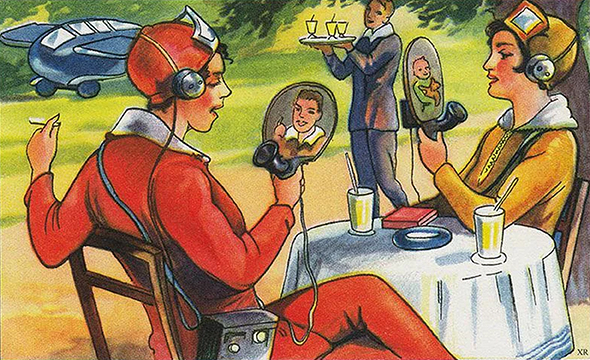 TELEPHONOSCOPE—Echte Wagner Album No. 3, series 12 and 13, 1930. Author unknown (public domain). |
Echte Wagner (which means ‘Genuine Wagner’) was a German brand of margarine, produced by the Wagner company in Elmshorn, Germany (in the Holstein region, starting in 1907 and closing around 1976. Along with margarine, Wagner offered collectible cards, marbles and plastic figures with purchases.
In 1930 it created the series known as Zukunftsfantasien (Imagining the Future) that included personal wireless communication devices seen here |
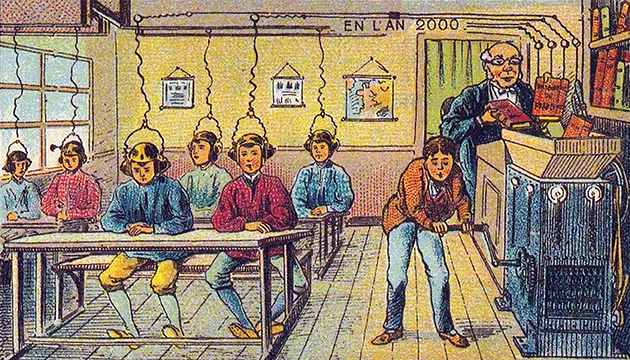 FUTURE SCHOOL IN THE YEAR 2000—Postcard by Jean-Marc Côté, c. 1900 (public domain). |
En L’An 2000 (In the Year 2000) is a French cartoon series imagining advances in science and technology that would be achieved by the year 2000. They were printed in 1899, 1900, 1901 and 1910, first on paper as cigar box inserts, and later as picture postcards, but never distributed. The only known set of the postcards was acquired by writer Isaac Asimov, who featured them in his nonfiction work Futuredays: A Nineteenth Century Vision of the Year 2000 (1986). |
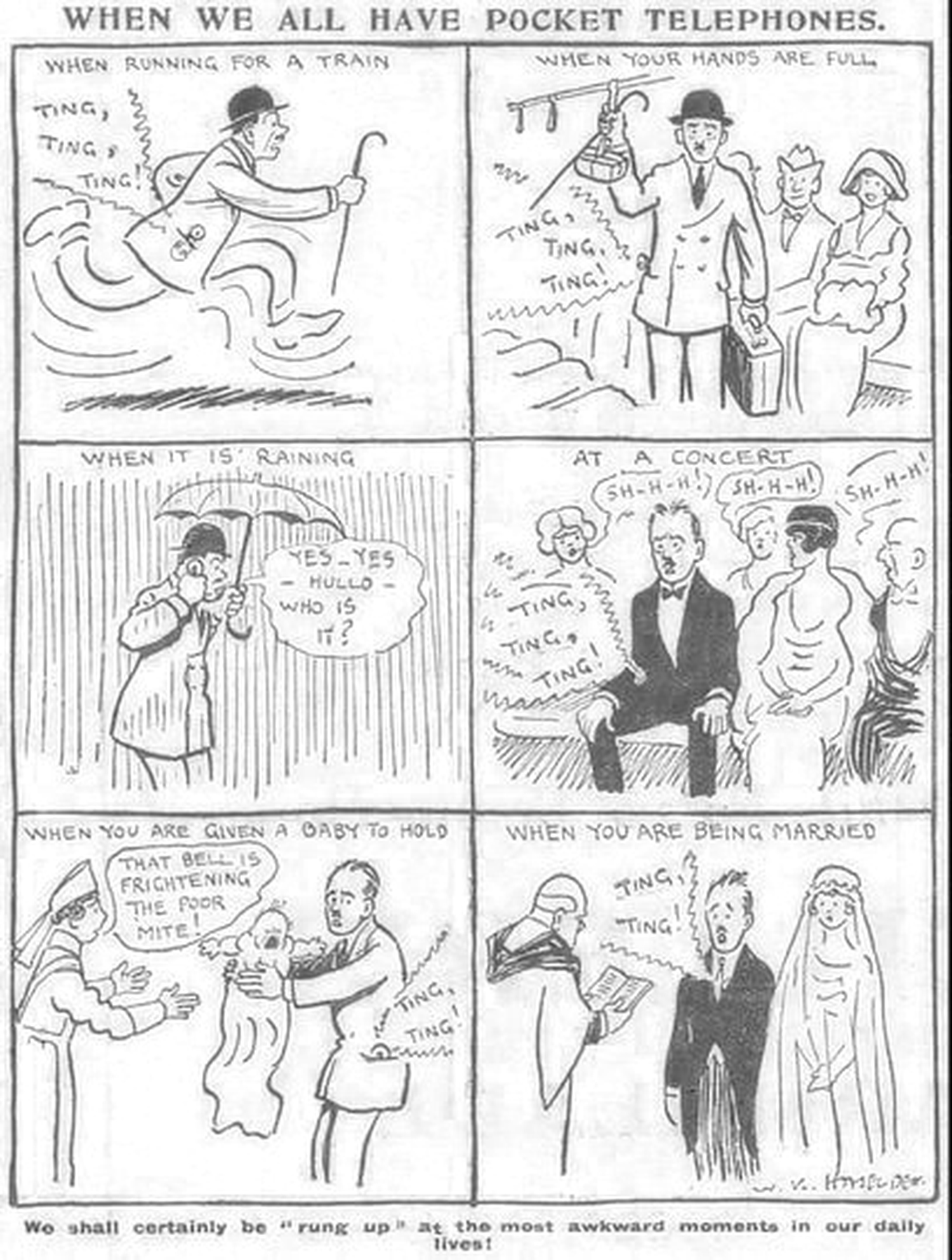 THE INCONVENIENCE OF POCKET PHONES—By W. K. Haselden, 1919, Daily Mirror (public domain). |
This cartoon was so accurate in predicting the inconvenience of cell phones that its authenticity was checked by Snopes.org. The fact-checking organization said it was, in fact, created by W. K. Haselden and first published in The Daily Mirror on March 5, 1919. It may have been a reaction to a March 2, 1919 report by the Marconi company about pocket telephones becoming available soon. |
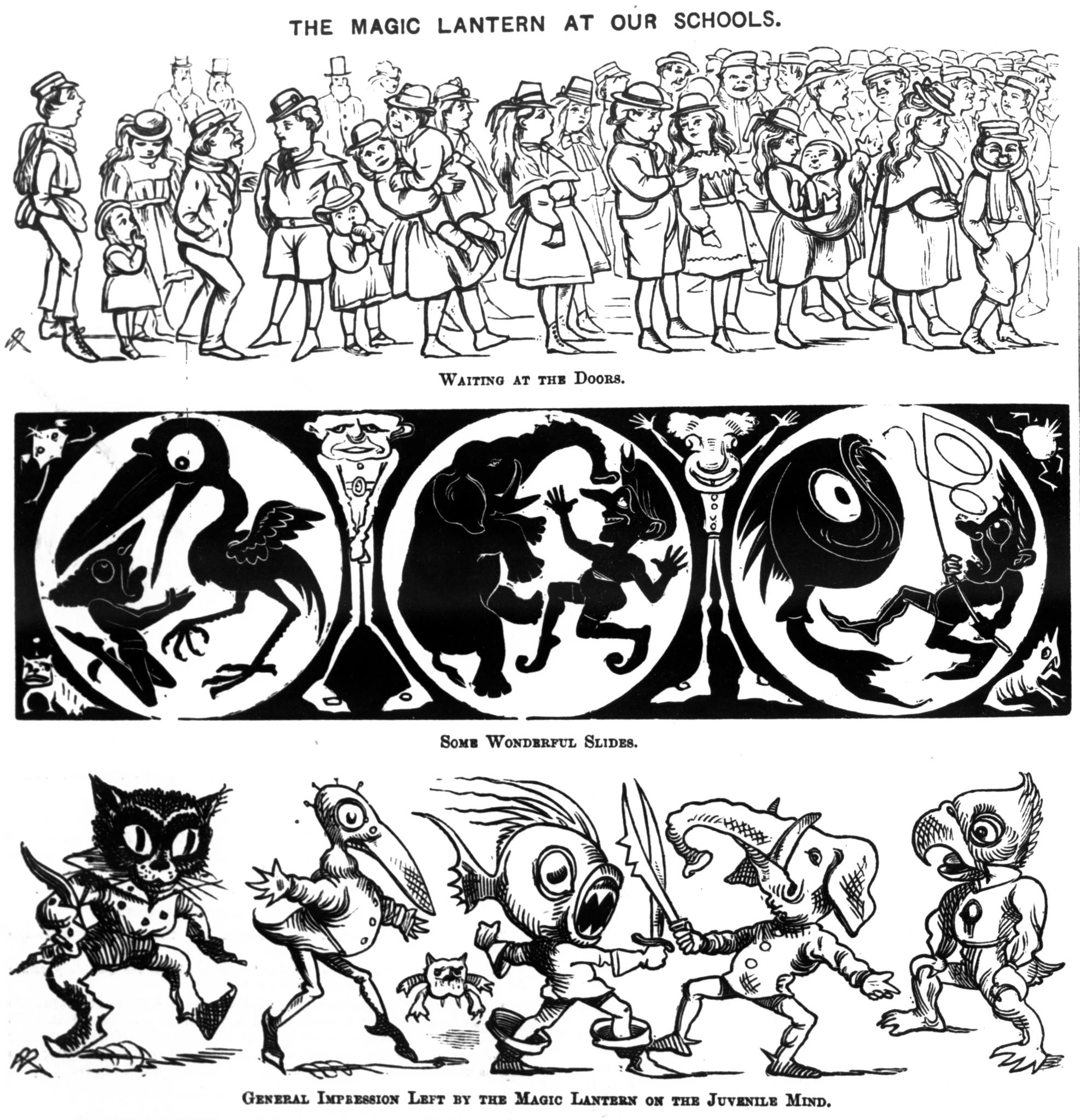 |
“The Magic Lantern at Our Schools,” takes a satirical at the 19th-century educational use of the magic lantern. In the top panel we see school children anticipating the show, then in the second panel we see the show itself, and in the third panel we see the surreal mental aftermath that children were thought to experience from over-exposure to visual media. (Also see Hall’s Catalog of magic lanterns, 1873.)
|
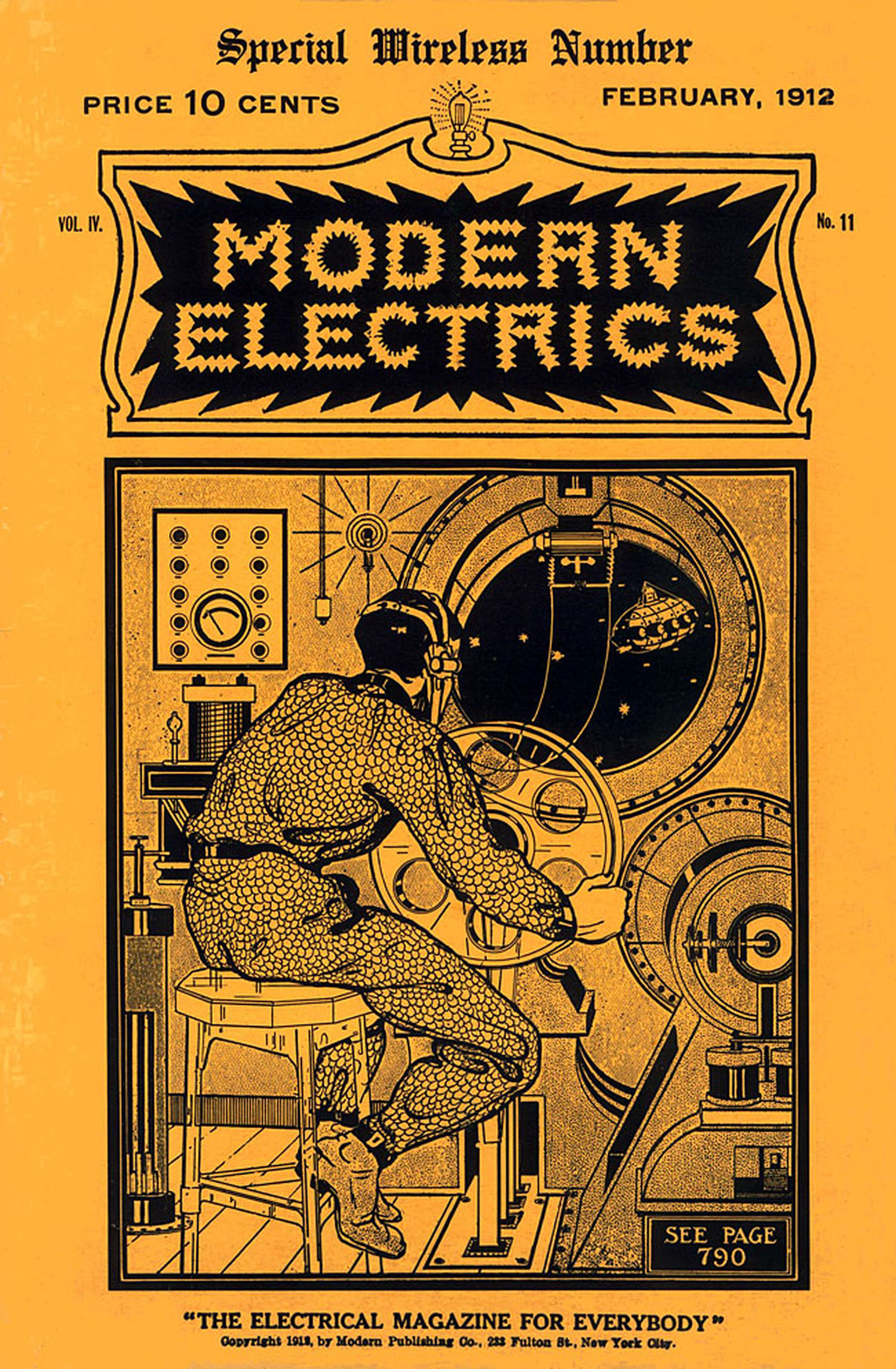 SPACE RADIO, RALPH 124C41+—By Hugo Gernsback, 1912, Modern Electrics (public domain). |
Ralph 124c 41+ (1911) by Hugo Gernsback was an early science fiction work with somewhat stilted writing. The title means “one to foresee for one another.” It contained insightful predictions including radar, television, the video phone, sound movies, voice printing, tape recorders, postage- stamp newspapers, and electronic writing. |
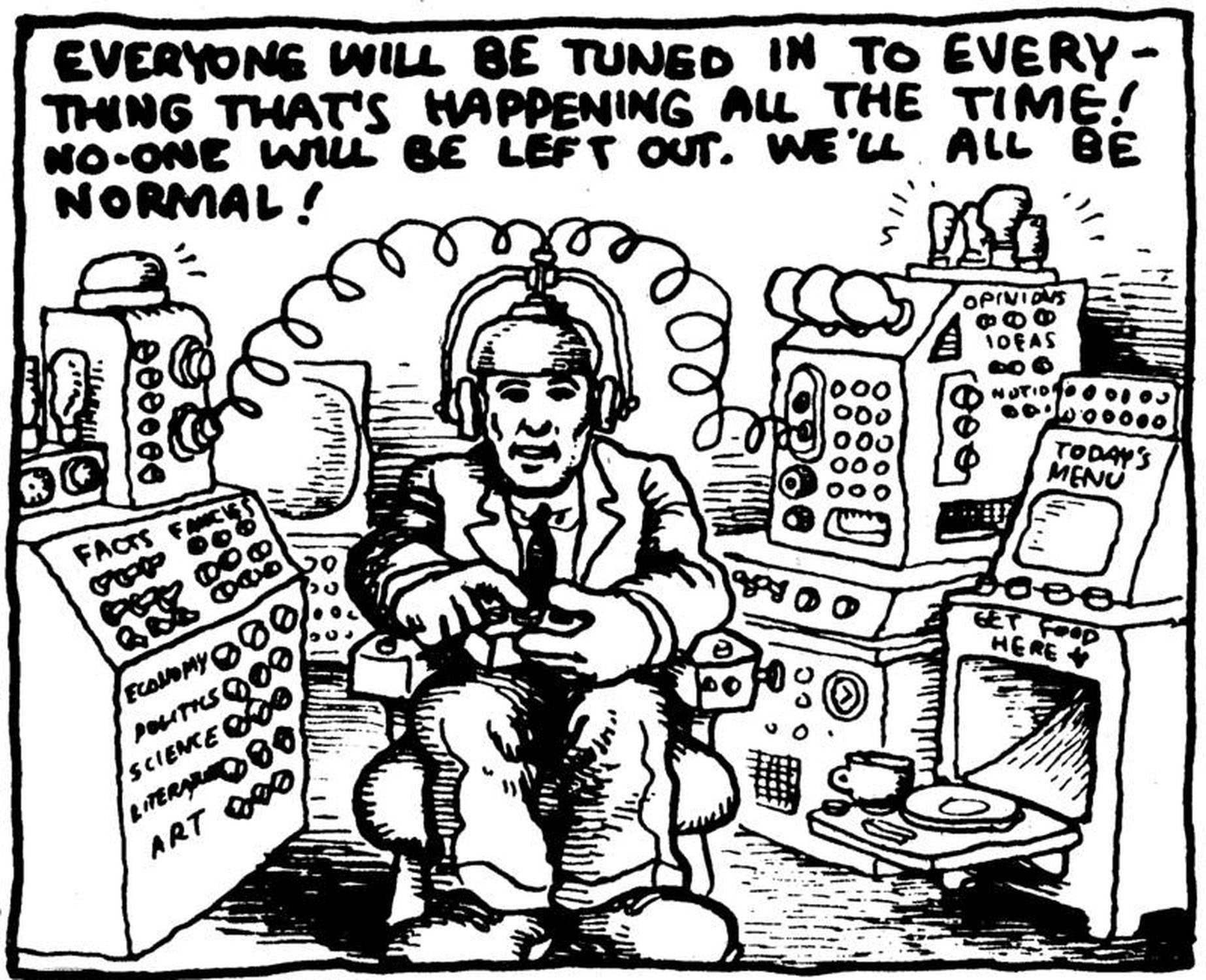 WE’LL ALL BE NORMAL—By Robert Crumb, 1967. |
City of the Future (1967, cartoon)— by Robert Crumb— depicts an average person tuned into everything that’s happening all the time. The many ways that personal normalization and socialization take place through media has been well explored in psychology. |
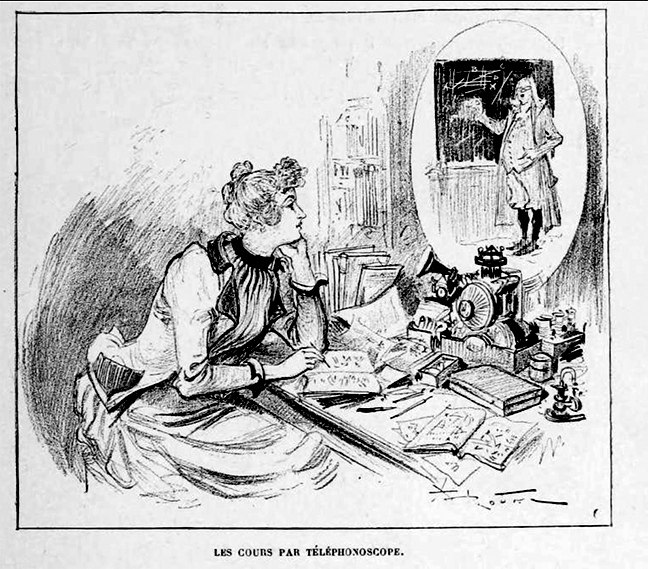 “Courses by telephone,” Alfred Robida, L’vie Electrique, 1892. |
Le Vingtième siècle. La vie électrique (1892) by Albert Robida depicts fictional characters George Lorris and Estelle Lacombe, who meet each other via the téléphonoscope as they enjoy video- recordings of great musicians. The “electric life” of the future, however, sweeps away history and tradition and leaves a sterile and powerless void. Here a young lady is taking a course by telephone. |
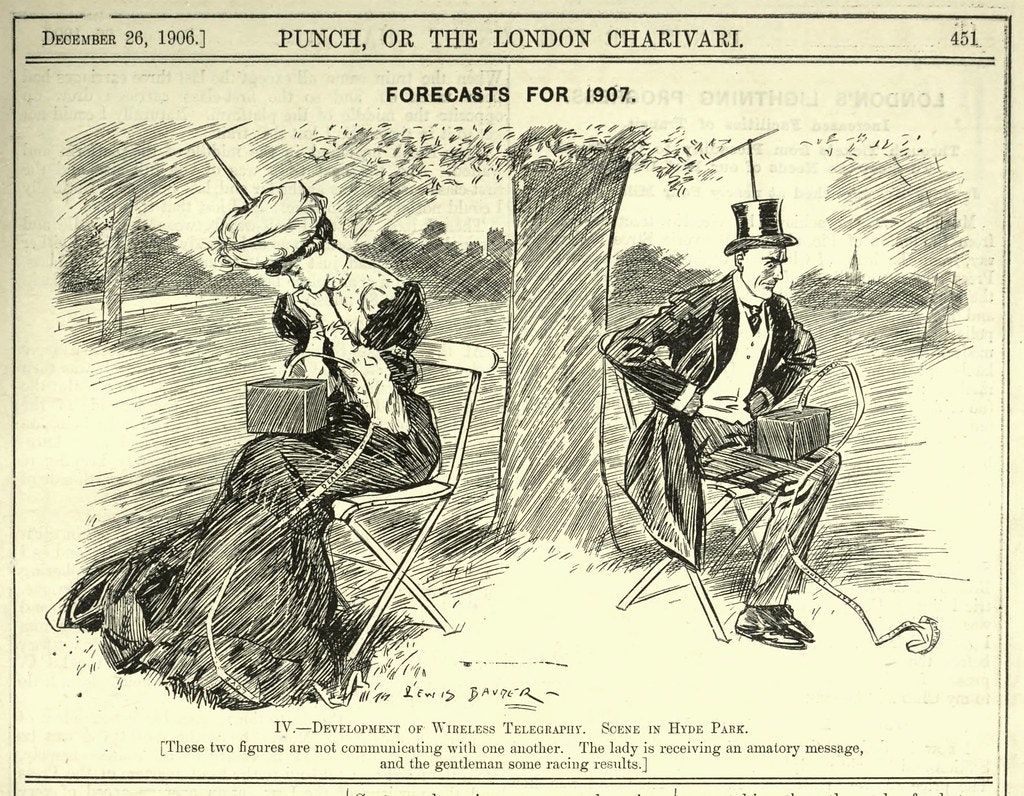 Forecasts for 1907, Punch magazine, Dec. 26, 1906. |
It’s interesting that Reginald Fessenden’s first radio-telephone broadcasts took place in Massachusetts only two days before this cartoon appeared in Punch magazine in London. It shows the awkwardness of radio telegraphy, even if it is printing out messages on ticker tape. The point here, as Public Domain Review notes, is that communications technology can be isolating rather than unifying, as was a common hope. |
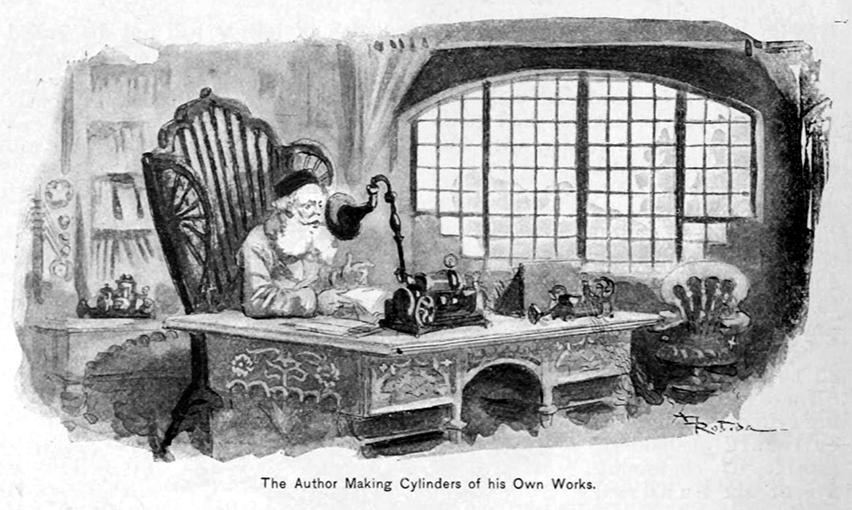 “The End of Books,” Octave Uzanne, Scribner’s Magazine, Vol. 16 (July–December 1894), 221–231. Public Domain Review. |
Uzanne’s article in Scribner’s depicts an author making cylinders (recordings) of his own works. |
Paris in the Twentieth Century (1863) by Jules Verne, depicts literature student Michel Dufrénoy, who uses fax machines, electronic music, and an internet- like system of communication. But the social impact is far from positive. He is appalled that education has shifted away from the humanities, and that fellow students laugh when he receives a diploma in literature. The book was not published in Verne’s lifetime. In other books, Verne anticipated television and commercials.
The Machine Stops (1909)— by E. M. Forster— is a short story about a mysterious machine that controls everything from food to information. All face- to- face communications are gone, and people meet through a kind of instant messaging/ video conferencing system. The protagonist, Kuno, lives only to share ideas. And when the machine stops, so does civilization. Kuno realizes too late that the natural world is what really mattered.
Nineteen Eighty- Four (1948)— by George Orwell— is a nightmarish vision of state totalitarianism and absolute mind control. It was a reaction to the Nazis and to Stalinism. The main instrument of daily control is the “telescreen,” a two-way television that is always on and covers all public and private spaces. It both transmits the propaganda of the totalitarian state of Oceana and also monitors the behavior of Oceana citizens with cameras and microphones. This forces citizens to be obedient and to hide thoughts and modify behavior.
Brave New World (1931) by Aldous Huxley describes a society in which people are separated into intellectual classes and oppressed mostly by their own addiction to amusement. In contrast to 1984, in which Orwell predicted a culture in totalitarian chains, Huxley’s Brave New World projected a trivializing culture in which people were preoccupied with pleasure from the feelies, the orgy porgy, and the “centrifugal bumblepuppy.”
Miracles You’ll See in the Next 50 Years (1950)— by science writer Waldemar Kaempffert, depicts Joe Dobson talking on the phone while also seeing other businessmen via television conferences. Meanwhile, Jane Dobson does much of her shopping by television.
Fahrenheit 451 (1953)— by Ray Bradbury is the story of a society where books are banned but nobody cares. Social life is limited because people consider the melodramas played on their “parlor wall” television screens to be as real as their family. People are inundated by an “electronic ocean of sound, of music and talk and music and talk, coming in on the shore of [your] unsleeping mind.”
Star Trek (1966, television series)— by Gene Roddenberry— often featured hand- held communications devices like the “communicator” and the “tricorder.”
2001 A Space Odyssey (1968, movie)— by Arthur C. Clarke— follows space travel to Jupiter and trouble with the AI computer HAL 9000. The movie also shows a “newspad” digital newspaper embedded in a dining room table, which resembles iPads and tablets.
The Hitchhiker’s Guide to the Galaxy (1979, book; 2005 movie dir. Jon Favreau) by Douglas Adams had its protagonist Arthur Dent use a “small, thin, flexible lap computer.”
Minority Report (1956, book; 2002 movie dir. Steven Spielberg)— by Philip K. Dick— shows a constantly updating e- newspaper in the year 2054, along with a barrage of highly personalized advertising as computers recognize the protagonist’s biometrics: “John Anderton! You could use a Guinness right about now.”
Rocannon’s World a 1966 novel by Ursula K. Le Guin featrures an “ansible“ — a fictional device capable of superluminal or faster-than-light (FTL) communication. An ansible can instantaneously transmit and receive data across vast distances. Similar devices are called ultraphones, ultrawaves, and interocitors.
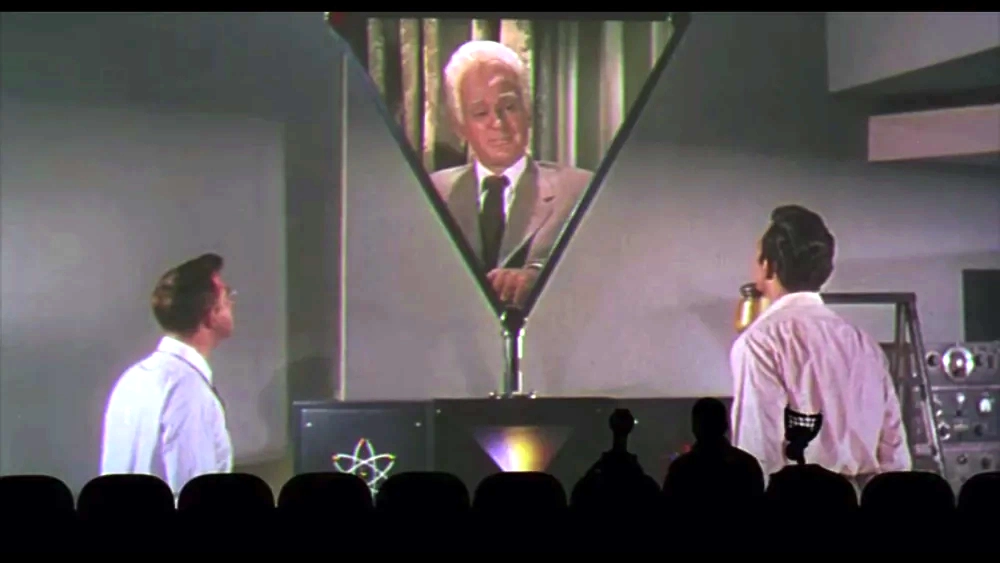
Two earthlings communicate with an extraterrestrial through an FTL interocitor in This Island Earth.
This Island Earth a 1952 science fiction book and cult 1955 film, features communication via an FTL device called an “interocitor.” The film was parodied by Mystery Science Theater 3000 (photo at right).
Iron Man (2008, movie dir. Jon Favreau)— Tony Stark uses a combination telephone and computer with a transparent screen in the visor of his Iron Man costume. Google tried this kind of ubiquitous heads- up display on eyeglasses as the “Google Glass” project in 2014. Safety, privacy, and other issues slowed the project down. BTW, the cartoon movie Iron Giant was based on the 1956 Iron Man book.