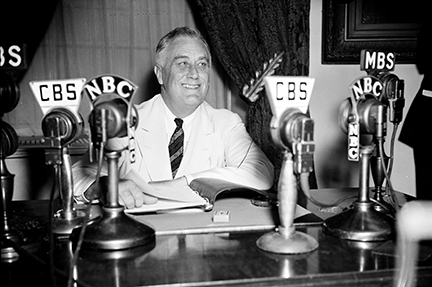
President Franklin D. Roosevelt during one of his many “Fireside Chat” radio addresses in the 1930s and 40s. (Library of Congress)
Summary
Chapter Eight covers radio from its invention in the 1890s to internet streaming radio today. A selection from this chapter is found in the Features section: Radio and the Titanic.
Like many new media forms, radio was highly regulated early on; but unlike most other media forms, radio (and television) broadcasting remained under the heavy hand of government regulation in the US and the rest of the world. This was, in part, because of the “scarcity rationale,” that is, the idea that the radio spectrum is limited, and not elastic like film, web sites and printed newspapers and magazines.
In developing nations, specifically Africa, Asia and Latin America, radio is the medium with the largest audience. Some of the most important initiatives for international broadcasting include Developing Radio, and Radio for Development, and the Caribbean broadcasting initiative. The idea of using radio for development is not at all new — the World Bank studied the concept in the 1970s, and use of radio for education goes back to its earliest days in the US and Europe.
Chapter outline
Press + to open
8 Radio: Like Discovering a New Continent 297
8.1 Auroras lead to equations 297
8.2 Like discovering a new continent: Maxwell, Hertz, Marconi 298
8.3 Radio and the Titanic 300
8.4 Early radio technology 303
8.5 The “radio craze” of the 1920s 304
8.6 Table of commercial radio frequencies 306
8.7 Radio licensing 306
8.8 The Golden Age of radio 307
8.9 Give me trouble: Mae West 308
8.10 Radio and the news 309
8.11 Martian invasion panics millions 310
8.12 Radio and censorship 311
8.13 Censoring hate speech on the radio 312
8.14 Radio’s culture wars 314
8.15 A regulatory philosophy for radio 315
8.16 Radio in the Second World War 315
8.17 “If I have offended you … I’m not in the least sorry” 317
8.18 The post-war Blue Book controversy 318
8.19 New competition for markets 319
8.20 The emergence of talk AM radio 321
8.21 Satellite radio 321
8.22 Copyright and music on the internet 322
8.23 Streaming and podcasting 324
8.24 The future of radio 325
No use whatsoever? How could someone as brilliant as Heinrich Hertz say that there was no practical use for his discoveries about radio?
Invention: Radio telegraphy was invented around the same time in India, Brazil, Italy and New York. The Italian inventor (Marconi) is almost the only one remembered by history. Why?
Titanic: How did radio telegraphy help and / or hurt in the Titanic disaster of 1912?
Regulation: What happened to WEVD (Eugene V Debs), a socialist radio station established in 1927 in New Jersey, or WCFL (Chicago Federation of Labor), a labor-oriented radio station established in 1926 in Chicago? How was that different from the FCC’s treatment of KFKB (owned a fake physician) in 1930 or KGBF (the right-wing Trinity Methodist Church) in 1933? How was Father Charles Coughlin, a right-wing pro-Nazi radio personality in the 1930s, different?
Oh the humanity: Herbert Morris made the 1937 Hindenburg disaster famous. What do we know about the Hindenburg disaster today?
War of the Worlds: Would people be frightened by a radio report of an invasion from Mars today? Why or why not? What made it frightening in 1938?
People & Events
Heinrich Hertz, Guglielmo Marconi, Reginald Fessenden, Edwin H. Armstrong, David Sarnoff, William S. Paley, Orson Wells, Herbert Morrison, Mae West, Amos n’ Andy, Edward R. Murrow, William L. Shirer, Father Charles Coughlin, Franklin D. Roosevelt,
Radio telegraphy, radio telephony, continuous wave versus spark, talk radio, radio censorship, fireside chats, War of the Worlds broadcast, controversy over news on radio, FRC regulation, Mayflower decision (leading to Fairness Doctrine, Ch 9); payola scandals, radio station ownership consolidation in Telecommunications Act of 1996, satellite radio, internet radio, MP3 players (iPods etc).
Documentary video and audio
The War of the Worlds, radio broadcast of the Mercury Theater, Oct 30, 1938, starring Orson Welles
Marconi’s plans for the world, 1912 — They included wireless telephony, wireless heating, wireless lighting, and wireless fertilizer. Hey, two out of four isnt bad.
Marconi calling— an extraordinary and innovative web site about the invention of radio telegraphy.
Sarnoff’s “Radio Music Box” memo, 1916 — Early Radio History web site.
“What these people need is radio,” Randall Patnode, Technology & Culture Vol. 44, No. 2 (Apr., 2003), pp. 285-305 . “In focusing on radio’s potential to redeem rural America, press accounts exaggerated the shortcomings of farm life, casting the farmer as an anti-modern “other” and indirectly lending support to an increasingly urban and modern way of life.”
Lone Ranger — Interesting background in the introduction, but the show starts at 1:08.
Mae West and Don Ameche in The Garden of Eden sketch, 1938. This gave the FCC serious heartburn.
The Shadow radio drama — This one is The Man Who Murdered Time, probably 1938. There are links to others on the YouTube page. at 3:30 on this page, there’s an interesting statement about radio itself: “Thirty years ago, the notion that a human voice could circle the earth would not only have been called fantastic, but impossible.”
Flash Gordon — The amazing interplanetary adventures of Flash Gordon and Dale Arden. This is the first episode broadcast in 1935 where he and Dale meet Professor Zarkov.
Boswell Sisters — Dancing Cheek to Cheek — one of the best-remembered early radio songs.
A Date with Judy radio comedy. Not well remembered today but funny and pitched to the feminine audience.
Jack Benny radio program Nov. 2, 1941 on NBC. Show starts at 1:55. A little more than a month later the world would change as America entered World War II.
Sherlock Holmes – Basil Rathbone and Nigel Bruce were favorites of the era. Murder in the Casbah was broadcast over Armed Forces Radio around 1943.
Little Orphan Annie was a cartoon character translated to radio in the 1930s. The actual story in this clip starts at 2:30, which gives you some idea of why the FCC was complaining about over-commercialization of radio at the time.
Power of radio news is apparent during a prion fire April 21, 1930 in Ohio. A line to the radio station, which had already been installed months before to pick up the prison band, now carried the sound of the riot and fire. One prisoner, identified only by number, described the fighting and confusion that killed 317 men. “The microphone was at the heart of the grim tragedy, at times no more than 30 feet away from the crackling flames,” said a New York Times account.
“No one in Europe wants to fight.” — Mutual Broadcasting Service’s John Steele tells Americans not to worry as Austria becomes part of Germany in March, 1938. (Also see Wikipedia background on what was called “the Anschluss.” And for more see the Nazis take over Austria March 1938.)
Nagasaki — British Group Captain Leonard Cheshire, designated as an observer of the US atomic bomb by Winston Churchill, reported for the BBC on the Aug. 9, 1945.
NPR is on the ropes, or at least, so says the Wall Street Journal, which has never been much in favor of public radio. New York Public Radio’s CEO Laura Walker talks about why it ain’t necessarily so.
Internet radio and royalties — For years, online services like Pandora have complained that rate schedules are much higher for Internet than for satellite radio. A bill called the Internet Radio Fairness Act is being considered in Congress.
Double loop learning: New York Times, Jan. 20, 2013: The rock band OK Go described how it once operated under the business model of the 20th-century rock band. But when industry record sales collapsed and the band members found themselves creatively hamstrung by their recording company, they questioned their tactics. Rather than depend on their label, they made wildly unconventional music videos, which went viral, and collaborative art projects with companies like Google, State Farm and Range Rover, which financed future creative endeavors. The band now releases albums on its own label.
Google exec says you can’t devalue music. And a few other worthy things about the future of radio. Digital Music News, Nov. 1, 2013. “It’s been called editorial music merchandising or content programming, but whatever you call it, the object’s the same. We’re here to help you through that maelstrom of musical choice… We’re not gatekeepers. We’re not taste-makers. We’re park rangers. Being a park ranger means our job isn’t to tell visitors what’s great and why. Our job is to get them from any given thing they like to a variety of other things they might. We may have our own favorite paths and being park rangers we probably even prefer the less crowded ones, but our job is to keep them all maintained so visitors to our park can chose their own adventure. They might not feel our hand on their backs as they wander, but it’s there. It’s just subtle. So how does that work in practice? Here are three guiding principles:
There should be no dead-ends.
There should be different recommendations for different people
Radio and the music industry were circumventing technologies for the boomer culture of the 50s – 70s. And a new audience was just what radio needed, according to radio DJ Casey Kasem. ( “Out of Thin Air,” (A&E, History Channel 1997). So musicians and comedians with social and political messages communicated through radio and rock and roll music, and it was powerful stuff: Rock n’ Roll music was banned in the Soviet Union until the 1980s, and is still heavily restricted in China and some Arab nations. But in the US and Europe, the safer versions of Rock n’ Roll songs were often aired by FM radio stations. Radio stations were limited, as noted in the song I Dig Rock n’ Roll Music. (“But if I really say it, the radio won’t play it, unless I lay it between the lines”). And hey, you could see they were having fun with this song.
When they couldn’t “really say it,” comedians (Bill Cosby, Steve Martin, George Carlin, Lily Tomlin and others) used LP (long playing) records, an older technology than radio, and also useful as a circumventing technology.
Radio Lovers – A variety of classics in radio plays.
Librivox — The audio equivalent of Wikipedia, all in the public domain.
Journalism heroes — A rich collection of radio plays about news men and women, organized by Bob Stepno.
NBC University Theater — A collection of classics intended to accompany “at home study” in the 1940s and 50s.
New Media 1740 – 1915 – A book challenging the notion that the study of new media doesn’t just mean today’s media. Moving beyond the story of technological innovation, the book considers emergent media as sites of ongoing cultural exchange. Examples range from familiar devices such as the telephone and phonograph to unfamiliar curiosities such as the physiognotrace and the zograscope.