
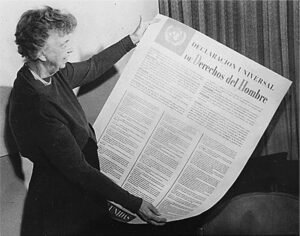
Former First Lady Eleanor Roosevelt holds the Universal Declaration of Human Rights.
A sweeping international history of mass communication should first take into account the great human ideals at the foundations of international law. These are best articulated in the Universal Declaration of Human Rights, and include the right to freedom of expression and press. The history of the League of Nations and United Nations communications work begins here in the next part of this section on international media history.
Secondly, this international history of communications media should open an understanding of world governing bodies and their special agencies, along with non-governmental organizations (NGOs) and the news and publishing organizations that serve the international community. (See excerpt from Ch. 12 of Revolutions in Communication).
In addition, it should survey each individual nation or region’s media history and address not only content and structural issues, but also take into account the biographical, social, political and technological aspects of media development over time. This is of course an interesting problem of scale, and were are only beginning to attempt it.
Finally, we need to explore the ways in which people have envisioned a universal communications system. Among the often-stated goals for the “global village” of satellite and digital systems are: better understanding between people; universal education for all; technical assistance for the least developed nations; and a basis for ending hunger, poverty, environmental degradation and human exploitation.
International Media NGOs
- Reporters without borders
- Committee to protect journalists
- World press freedom committee
- Article 19 (organization promoting Article 19 of the UN Charter of Human Rights)
- International media support
- International fund for public interest media
- Media landscapes, European Journalism Centre
International wire services
- Wire services (Reuters, AP, AFP, DPA, EFE, Xinhua, Internews, InterPress, etc)
- EFE wire service (Spain, Latin America)
- Xinhua wire service (China)
- History of News Agencies
- Internews
- Oliver Boyd-Barnett, News agencies in the turbulent era of the Internet (Catalonia, 2010). Available as a free e-book; excellent international resource.
Print media
- History of newspaper publishing
- General history of newspapers and magazines
- List of all major world newspapers
- List of world’s leading newspapers by circulation
- World newspapers and media
Electronic and digital media
- World Broadcasting Unions
- List of television networks by country
- History of television
- Internet censorship by country
- Concentration of Media Ownership