
Before printing
- The alphabets and the Alphabet Effect (Wikipedia). The Alphabet effect is a hypothesis in communication theory that says alphabets (as opposed to non-phonetic scripts) encourage the cognitive skills of abstraction, analysis, coding and classification. Also see Extra Credits history of the Alphabet.
- How Writing Began. (From “The Earliest Precursor of Writing” by Denise Schmandt-Besserat, (c) 1978, Scientific American).
- Walter Ong, Orality and Literacy. Ong’s idea, shared by many, was that a fundamental shift in thinking takes place when cultures move from oral to written communication.
- Extra credits history of writing , Jun 4, 2016 — How did the ancient civilization of Sumer first develop the concept of the written word? It all began with simple warehouse tallies in the temples, but as the scribes sought more simple ways to record information, those tallies gradually evolved from pictograms into cuneiform text which could be used to convey complex, abstract, or even lyrical ideas.
- Discovery of the Diamond Sutra, a reflection on the world’s oldest book printed with wood blocks. Huffington Post, 2012.
The invention of printing

Spread of printing 1450-1500 (Wikipedia).
-
-
- Who was Johannas Gutenberg?
- The Gutenberg Bible – 1455, (British Library)
- “Hark the Herald Angels ” — The familiar Christmas carol was originally a celebration of of the life of Johannas Gutenberg.
- The Atlas of Early Printing – The University Of Iowa Libraries
- Williamsburg Va print shop recreation.
- Gutenberg bio (via Wayback Machine) at Reformation history site.
- History world’s history of printing.
- Women of the Press (Spain) 1500s – 1800s.
- Printing and the Renaissance, 1921 paper.
- Incunabula — An excellent National Diet Library of Japanese site describing in detail the origin and study of “incunabula” (early printed texts 1455 – 1500).
-
Religious impacts of printing
-
-
- European wars of religion 1520s – 1640s (Wikipedia)
- Effects of the invention of printing.
- Elizabeth Eisenstein (Wikipedia). Eisenstein argued that the impact of printing should have been obvious all along.
- In contrast to Eisenstein, Leopold Von Ranke seems to have missed the impact of printing in his History of the Reformation in Germany.
- Printing revolution and the fall of religious authority. Student site, not very serious, but funny.
- Seven Ways the Printing Press Changed the World. History Channel.
- McLuhan & Ong on the Cultural Shift From Orality to Literacy
-
The Enlightenment
-
-
- The Founders Constitution: University of Chicago web publication of major documents from the Enlightenment.
- John Milton’s Aeropagitica 1644.
- Maryland Toleration Act, 1649
- John Locke – A letter concerning toleration, 1689
- John Locke – Treatises Concerning Civil Government, 1690
- Cato was the pen name of Trenchard and Gordon, two English essayists who were well known in the early to mid 18th century.
- Cato Letters No. 15 On Freedom of Speech –“Without freedom of thought, there can be no such thing as wisdom; and no such thing as publick liberty, without freedom of speech: Which is the right of every man, as far as by it he does not hurt and control the right of another; and this is the only check which it ought to suffer, the only bounds which it ought to know…”
- Cato Letters No. 59 Liberty an Inalienable Right of All Mankind “All men are born free; liberty is a gift which they receive from God himself; nor can they alienate the same by consent, though possibly they may forfeit it by crimes. “
- Notes on the State of Virginia, Thomas Jefferson, 1782
-
Political impacts of printing
-
-
- Proceedings of the Old Bailey, London, 1674 to 1834. Searchable database. Suggestion: Search the proceedings for the crime of “libel.”
- Fifty books that changed the world — Online Education Database
- The English Book Trade — With a transcript of the 1664 trial of John Twyn and other arguments for a free press.
-
From colonies to independent states
-
-
- Raleigh’s First Roanoke Colony.Sir Ralph Lane, 1585
- A Briefe and True Report of the New Found Land of Virginia by Theodorus de Bry, 1590.
- Instructions for the Virginia Colony, 1606
- A true narrative concerning Bacon’s Rebellion in Virginia, 1676
- A Journey to the Land of Eden, by William Byrd, 1728 – 1736.
- The Poor Unhappy Transported Felon’s Sorrowful Account of His Fourteen Years Transportation, at Virginia, in America. By James Revel. (Undated, around 1700).
- The trial of New York printer John Peter Zenger in 1734 had a lasting influence on the development of free speech in America.
- Top ten newspapers of the American Revolution.
- The Great Law of Peace, Constitution of the Iroquois Nation
- Ben Franklin’s Silence Dogood Also: context of the Silence Dogood and Polly Baker hoaxes
- Ben Franklin’s autobiography.
- The Many-Sided Franklin, an excellent biography with extensive information about his career as a printer, 1899 book by Paul Leicester Ford.
- Boston News-Letter May 14, 1761. This is really an ordinary issue of the newsletter, mostly full of European news, that gives you an idea of the conditions and priorities of the era. American revolution
- Pennsylvania Gazette on the Stamp Act.
- Boston Massacre, 1770.
- Samuel Adams on the Rights of the Colonists. 1772 Yes, this is the Sam Adams better known today through a brand of beer. Note his religious intolerance.
- Documents of the American Revolution including John Dickenson, Samuel Adams, etc.
- Thomas Paine: Common Sense 1776 Considered the best articulation of the revolutionary position. Also see: The American Crisis. “These are the times that try men’s souls… “
- Virginia Declaration of Rights June 1776 This revolutionary document was the foundation for the French Declaration of the Rights of Man and of Citizen Aug. 26, 1789 and the US Bill of Rights (passed in 1791). The Virginia Declaration is still the basis of the Virginia state Constitution.
- James Rivington, Tory printer in New York during the American Revolution, possibly a spy for the revolutionaries.
- From the diary of Ebenezer Denny, 1781 describing the surrender of Cornwallis at Yorktown
- Partisan press and the Federalist and Anti-Federalist papers.
- Would there have been an American revolution without newspapers or the mail?
- Hamilton, meet Enemy of the People, by Jeff Biggers, February, 2017, Huffington Post.
- William Cobbett, British American printer and activist
-
French revolution
-
-
- French Declaration of the Rights of Man and of Citizen Aug. 26, 1789
- “The Fourth Estate” from Thomas Carlyle’s history, The French Revolution. (Chapter 1.6.V)
- Liberty, Equality, Fraternity — Exploring the French Revolution
-
Printing culture
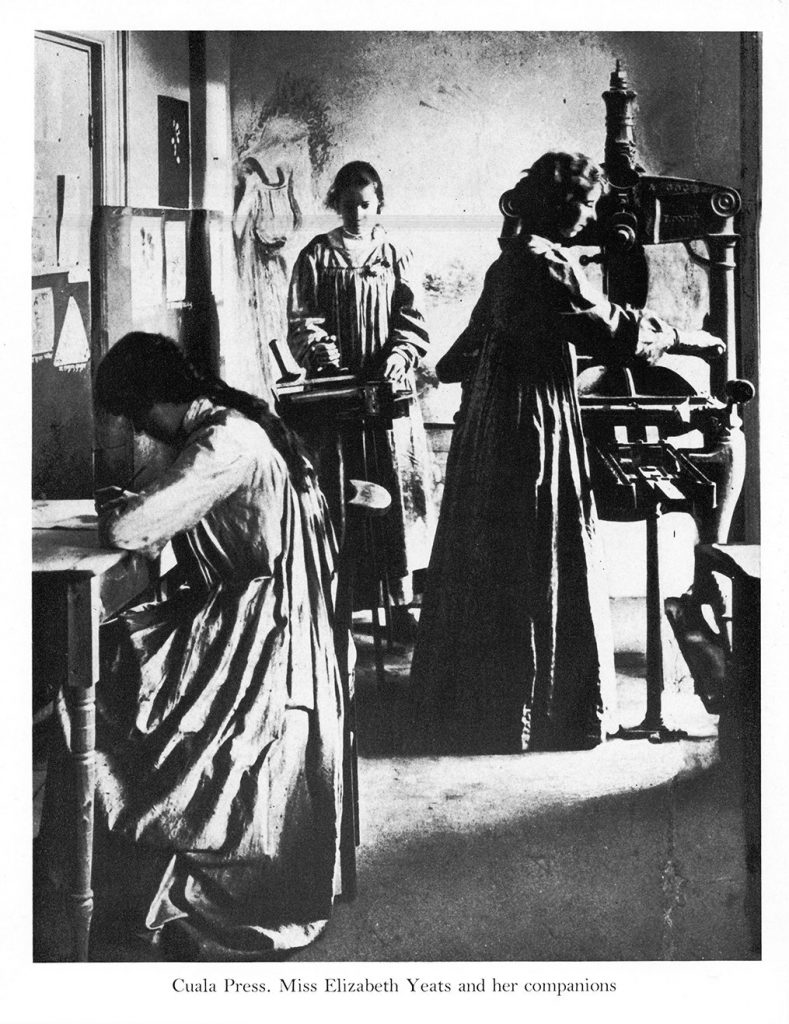
The Dun Emer press-room, ca. 1903, Dublin, Ireland. Elizabeth Corbett Yeats, sister of famed poet William Butler Yeats, is at the iron hand-press. Yeats hoped to make book printing an art form. Beatrice Cassidy, standing, is rolling out ink, and Esther Ryan is correcting proofs at the table. See Rebecca W. Davidson’s “Unseen Hands: Women Printers, Binders and Book Designers”
-
-
- Gertrude Rawlings, The Story of Books, (1917)
- Charles Timperly, A Dictionary of Printers and Printing (1839)
- William Blades, The Pentateuch of Printing: With a Chapter on Judges (1891)
- Henry Noel Humphreys, A history of the art of printing, (1868)
- Henry Oscar Houghton, Address on early printing in America (1894) – Note – Start halfway through, bypassing the Senator’s remarks.
- Soc. for Promoting Christian Knowledge, History of printing (1855)
- Tramp printers — A collection of stories about printers in the American West.
- The Invention of News – European history of early printing and news organizations, Salon Magazine, March 2014.
- Printing museums in the US
-
Histories of printing
-
- Joseph Moxon Mechanick Exercises: Or, The Doctrine of Handyworks (1683) – Note, towards end there are interesting remarks about life and customs in the printing chapels
- Frederick Hamilton, A brief history of printing in England (1918)
- Joel Munsell, Outline of the history of printing (1839)
- Samuel Palmer, General history of printing (1733)
- Philip Luckombe, The History and Art of Printing: In 2 Parts (1771)
- Thomas Hansard, The Art of Printing: Its History and Practice (1851)
- Lawrence Wroth, A History of Printing in Colonial Maryland, 1686-1776 (1922)
- Joseph Ames, Typographical antiquities: an historical account of printing …
- Gertrude Rawlings, The Story of Books, (1917)
- Charles Timperly, A Dictionary of Printers and Printing (1839)
- William Blades, The Pentateuch of Printing: With a Chapter on Judges (1891)
- Henry Noel Humphreys, A history of the art of printing, (1868)
- Henry Oscar Houghton, Address on early printing in America (1894) – Note – Start halfway through, bypassing the Senator’s remarks.
- Soc. for Promoting Christian Knowledge, History of printing (1855)
- Pierre Simon Fournier, Manuel typographique, 1762
- Robert Hoe, A Short History of the Printing Press and of Improvements in Printing Machinery from the Time of Gutenberg up to the Present Day (1902).
- Frank Shaw, The Printing Trades (1916).
- Library of Congress: Printing Newspapers 1400 – 1900