
from Chapter 7 of Revolutions in Communication
Telegraph and telephone are usually considered one-to-one communications devices; however, both also had an important place in the mass media. The telegraph linked the world’s newspapers in the 19th and 20th centuries through “wire services” such as the Associated Press in the US, Reuters in Britain, Havas in France and Wolff’s in Germany. The telephone system carried radio signals from New York to the rest of the nation in the early decades of the radio age; it was indispensable in establishing a centralized broadcasting system in the US and Europe. In both cases, many people who wanted a more decentralized, responsive and democratic information system were disappointed with the monopolistic way the networks developed.
In the US, the telegraph became a monopoly when Western Union absorbed all of the 500 companies that were established between 1844 and the 1860s. The Western Union – Associated Press monopoly was such a thorn in the side of American reformers in the late 19th century that they financed research into Alexander Graham Bell’s telephone — an important example of a technological circumvention around a communication bottleneck.
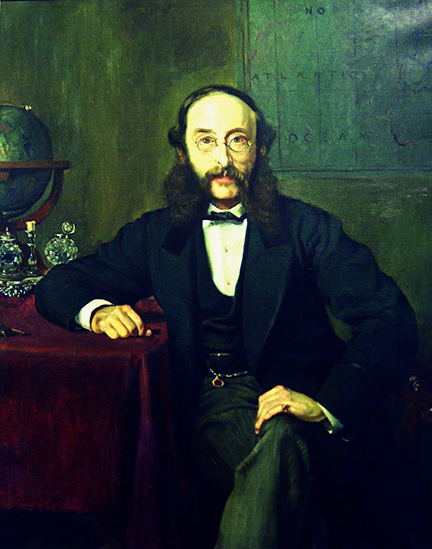
Julius Paul Reuter
In Europe, Charles Louis Havas, Paul Reuter, and Bernhard Wolff changed the world by creating news agencies that used the telegraph to rapidly transmit information.
Charles-Louis Havas (1783–1858) started his working life as a supply officer for the French military, serving in Nantes, France. Later he was a banker, a cotton importer, and a newspaper entrepreneur. Because of his work in both imports and news, he found it easy to view information as an international commodity. In 1830, following the July Revolution, Louis-Philippe succeeded to the French throne. Having strong liberal tendencies, Louise-Philippe proclaimed freedom of the press, and Havas saw the need for better organization of information and news traffic (Havas 2015). His first step was to set up a foreign newspaper translation bureau in Paris. The bureau was also a bookstore and a focal point of international politics and information. Three years later it became Agence Havas, the world’s first news agency (Shrivastava 2007).
In the beginning, Havas used carrier pigeons to bring news from the morning’s British newspapers to Paris by 3.00 p.m., in time for the evening editions. When the telegraph arrived in France in 1845, Havas was the first to use it. The Havas agency became a publicly traded company after the death of Charles-Louis Havas in 1858, and was the largest of the world’s news agencies for almost a century.
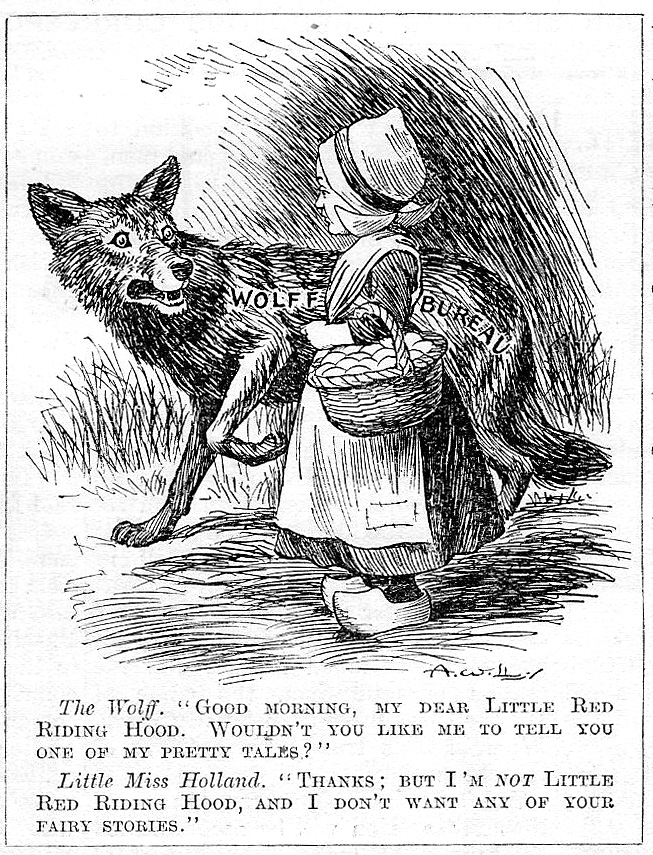
1914 British political cartoon depicting the big, bad “Wolff” telegraph service leading the Dutch astray.
Bernhard Wolff and Paul Reuter were two Havas employees who, with the help of Havas, founded two other major telegraphic news agencies. Wolffs Telegraphisches Bureau started in Berlin a year after the Revolution of 1848 and the liberalization of press laws. Wolff was manager of the National Zeitung, founded that year, which started a policy of carrying news dispatches by telegraph from Paris, London, Amsterdam, and Frankfurt. By 1869, WTB was so closely associated with the government that it had offices in the main postal and telegraph building.
Paul Reuter was a journalist and bookstore owner who married a British banker’s daughter. He and his wife left Germany after the collapse of the revolution of 1848 and he began working for Havas in Paris as a translator. Seeing opportunity in the expanding telegraph, Reuter moved to Aachen, Germany, in October of 1849 and opened a news and stock service. Aachen, that year, was the end of the line for the telegraph from Berlin. When the French opened a telegraph line from Paris to Brussels, Reuter was in the middle.
He began filling in the 140-kilometer (90 mile) gap across the border by using carrier pigeons and express riders. As the telegraph network expanded, Reuter stayed ahead. He moved to London and opened an office in the heart of the city’s financial center one month before the new London–Paris submarine telegraph cable started operating.
Havas was also influential in the creation of other news agencies. Guglielmo Stefani (1819–61) was a journalist from Venice who joined the 1848 revolution and fought for Italian independence from Austria. He was imprisoned by the Austrians but then exiled, and in 1853, with help from Havas, he set up Agenzia Telegrafica Stefani. After his death, Havas acquired half of the agency, which continued as the major Italian news agency until 1945.