
Summary
To study history, we need to begin by asking questions about history and historians. This provides basic information and links.
Who were the great historians?
- Ecclesiastes: (c. 200 BCE) “Let us now sing the praises of famous men, our ancestors in their generations.” Myth-making is a powerful motivation for history. (Writer James Agee and photographer Walker Evans used this idea as the title of a 1941 book about Southern sharecroppers. Columnist William F. Buckley pondered the phrase in an essay about Winston Churchill.)
- Herodotus: (484 – 420 BC) “These are the researches of Herodotus of Halicarnassus, which he publishes, in the hope of thereby preserving from decay the remembrance of what men have done, and of preventing the great and wonderful actions of the Greeks and the Barbarians from losing their due meed of glory…” Written 440 B.C.
- Thucydides: (460 – 400 BC) “The way that most men deal with traditions, even traditions of their own country, is to receive them all alike as they are delivered, without applying any critical test whatever… The absence of romance in my history will, I fear, detract somewhat from its interest; but if it be judged useful by those inquirers who desire an exact knowledge of the past as an aid to the interpretation of the future, which in the course of human things must resemble if it does not reflect it, I shall be content. In fine, I have written my work, not as an essay which is to win the applause of the moment, but as a possession for all time.” (Written 431 B.C.)
- Tacitus (Publius Cornelius Tacitus — c. AD 56 – 117) — “After the Battle of Actium, when the interests of peace were served by the centralization of all authority in the hands of one man, there followed a dearth of literary ability, and at the same time truth suffered more and more, partly from ignorance of politics, which were no longer a citizen’s concern, partly from the growing taste for flattery or from hatred of the ruling house. So between malice on one side and servility on the other the interests of posterity were neglected. But historians find that a tone of flattery soon incurs the stigma of servility and earns for them the contempt of their readers, whereas people readily open their ears to the criticisms of envy, since malice makes a show of independence.” (From the preface to The Histories, 69 ACE).
- Edward Gibbon (1737 – 1794) Author of the Decline and Fall of the Roman Empire, published in 1776, one of the first modern histories. Gibbon’s ironically lively writing style, and his motive in writing historyu, is seen in this passage, where he discusses ancient Roman ruins. These are “rendered more interesting, by two important circumstances, which connect the agreeable history of the arts with the more useful history of human manners. Many of those works were erected at private expense, and almost all were intended for public benefit.”
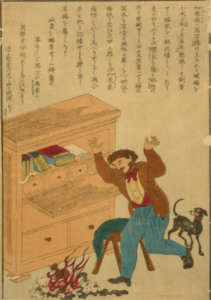 Thomas Carlyle (1795 – 1881) — Historian and journalist who believe in entertaining as well as informing, Carlyle’s history of the French Revolution influenced Charles Dickens as he wrote A Tale of Two Cities. Carlyle wrote the book twice — the first time the manuscript was inadvertently burned (as illustrated in a Japanese print depicted here).
- Leopold Von Ranke: (1795 – 1886) Father of the “scientific” approach to history, as opposed to Carlyle’s entertaining approach, who said historians should report “The Way Things Really Were.” Von Ranke said: “To accomplish something in history there are three requirements: a sound understanding of people, courage, and honesty. The first, simply for insight into things; the second, not to be shocked at what one finds there; and the third, not to dissemble in any particular, even to oneself. So do the simplest moral qualities govern, even in science” (Diaries, c1843)
- George Bancroft (1800-1891) Author of “A History of the United States” (1834). “The movements of humanity are governed by law… The growth and decay of empire, the morning lustre of a dynasty and its fall from the sky before noonday; the first turning of a sod for the foundation of a city to the footsteps of a traveller searching for its place which time has hidden, all proceeds as it is ordered. The character of science attaches to our pursuits.” (Address to the American Historical Association April 27, 1886)
- Lord John Edward Emerich Acton (1834-1902) “Power tends to corrupt, and absolute power corrupts absolutely.” In an 1887 letter, Acton wrote to Mandell Creighton, a historian of the papacy and a bishop in the Church of England, saying that the role of historians is not to excuse great crimes.
- “Historic responsibility has to make up for the want of legal responsibility. Power tends to corrupt, and absolute power corrupts absolutely. . . The inflexible integrity of the moral code is, to me, the secret of the authority, the dignity, the utility of History. (We should not debase history by excusing men of rank). Then History ceases to be a science, an arbiter of controversy, a guide of the Wanderer, the upholder of that moral standard which the powers of earth and religion itself tend constantly to depress. It serves where it ought to reign; and it serves the worst cause better than the purest.
Acton is also remembered for his “History of Freedom” project. “For our purpose, the main thing to learn is not the art of accumulating material, but the sublimer art of investigating it, of discerning truth from falsehood and certainty from doubt… Opinions alter, manners change, creeds rise and fall, but the moral law is written on the tablets of eternity.” From the Inaugural lecture on the study of history.
- “Historic responsibility has to make up for the want of legal responsibility. Power tends to corrupt, and absolute power corrupts absolutely. . . The inflexible integrity of the moral code is, to me, the secret of the authority, the dignity, the utility of History. (We should not debase history by excusing men of rank). Then History ceases to be a science, an arbiter of controversy, a guide of the Wanderer, the upholder of that moral standard which the powers of earth and religion itself tend constantly to depress. It serves where it ought to reign; and it serves the worst cause better than the purest.
- Henry Adams (1838 – 1918) — Best known for his autobiographical “Education of Henry Adams,” Adams sees history as an expansion of thermodynamic power and humanity as being unable to control its trajectory. While in the 18th century “history muttered down Fleet Street” (in London), at the dawn of the 20th century, “the two-thousand-years failure of Christianity roared upward from Broadway” (in New York).
- In an 1894 address to the American Historical Association, Adams took issue with Von Ranke and said he doubted whether a practical “science” of history could ever be established. Even if it could, he said,
“Hitherto our profession has been encouraged, or, at all events, tolerated by governments and by society as an amusing or instructive and, at any rate, a safe and harmless branch of inquiry. But what will be the attitude of government or of society toward any conceivable science of history? We know what followed Rousseau; what industrial and political struggles have resulted from the teachings of Adam Smith; what a revolution and what vehement opposition has been and still is caused by the ideas of Darwin. Can we imagine any science of history that would not be vastly more violent in its effects than the dissensions roused by anyone or by all three of these great men?
- George Santayana (1863 – 1952) “Those who cannot remember the past are condemned to repeat it,” (The Life of Reason, 1905). The Harvard philosopher’s statement about history is probably the best known historical concept.
- Samuel Elliot Morrison (1887-1976), a naval historian, won a Pulitzer prize for his biography of Christopher Columbus, later criticized for emphasizing the explorer’s devout faith and skipping quickly over his massacres. He wrote: “American historians, in their eagerness to present facts and their laudable concern to tell the truth, have neglected the literary aspects of their craft. They have forgotten that there is an art of writing history.”
- Allan Nevins (1890 – 1971) — (Journalist/ historian) “Imagination is essential to re-creation of the past, and it is re-creation at which the historical artist aims… [a good history] shows us the workings of the human heart.” (From “The Old History and the New,” Allan Nevins on History). Also: Where the differences lay(comparing North and South prior to the Civil War).
- Herbert Butterfield (1900 – 1979) Whig history is “the tendency of many historians to write on the side of Protestants and Whigs, to praise revolutions provided they have been successful, to emphasize certain principles of progress in the past and to produce a story which is the ratification if not the glorification of the present.”
- Harold Innis (1894 – 1952) — Economic historian who put communication at the center of history. Civilizations that had communication through durable media were biased (oriented) towards time and orthodoxy (Egypt, Babylon); On the other hand, civilizations with flexible media (Rome, Greece) were biased towards control of space and a secular, scientific approach to life.
- Marshall McLuhan (1911 – 1980) — Media critic who also put communication at the center of history. Most famous quote: “The medium is the message.” About history: “We look at the present through a rear-view mirror. We march backwards into the future.”
Modern perspectives on history

Howard Zinn, 2009
- Howard Zinn (1922 – 2011) History as a weapon: “History is invoked because nobody can say what history really has ordained for you, just as nobody can say what God has ordained for you. Political leaders suppose that the population is as mystified by the word history as they are by the word God, and that therefore they will accept whatever interpretation of history is given to them…” (from Original Zinn, Harper Perennial, 2006). Note: Compare this to Thucydides’ (above) about receiving traditions without any critical test.
Zinn’s ideas continue to be controversial. A 2026 book, The People’s Historian, describes right-wing outrage over his focus on the negative truths about American history. Others, such as American Teacher and New Republic criticized his approach, mostly on the basis of the greatness of America that Zinn supposedly undermined. - A New York Times review of The People’s Historian, a 2026 biography said: “There are good reasons Zinn’s “A People’s History” has sold more than four million copies since it was first published in 1980. It introduced readers to figures like the socialist activist and presidential candidate Eugene Debs, the labor organizer Big Bill Haywood, the anarchist Emma Goldman, the abolitionist Frederick Douglass and the slave revolt leader Nat Turner who were mentioned only briefly or not at all in the ponderously upbeat textbooks of half a century ago.”
- James W. Loewen — (1942 – present) Lies my teacher told me: Everything Your American History Textbook Got Wrong “History is furious debate informed by evidence and reason, not just answers to be learned. Textbooks encourage students to believe that history is learning facts. “We have not avoided controversial issues” announces one set of textbook authors; “instead, we have tried to offer reasoned judgments” on them – thus removing the controversy! No wonder their text turns students off!?”
- Francis Fukuyama — (1952 – present) Because nearly every nation has adopted liberal democracy, or is approaching it, we are facing The End of History — “What we may be witnessing is not just the end of the Cold War, or the passing of a particular period of post-war history, but the end of history as such… That is, the end point of mankind’s ideological evolution and the universalization of Western liberal democracy as the final form of human government.
- Abraham S. Eisenstadt (1920 – 2007) Houghton Mifflin Companion to US History: “What then are this generation’s historians saying about the major themes that have run through American historical writing? They have retreated from celebrating America’s Providential role among the nations, its mission as a city on a hill, and the singularity and exceptionalism of its society. Although some have stressed the interwoven American principles of liberty and democracy, most have turned away from a larger vision, focusing instead on different aspects of society and on localities rather than the nation as a whole. In lieu of their earlier concentration on a mainstream, essentially Anglo-American politics and culture, they have been increasingly concerned with racial, ethnic, religious, generational, and sexual groups striving for civic and legal equity. If they seem to have no unifying vision of their past, that may very well be because they are too close to their own time to gain its overall measure.”
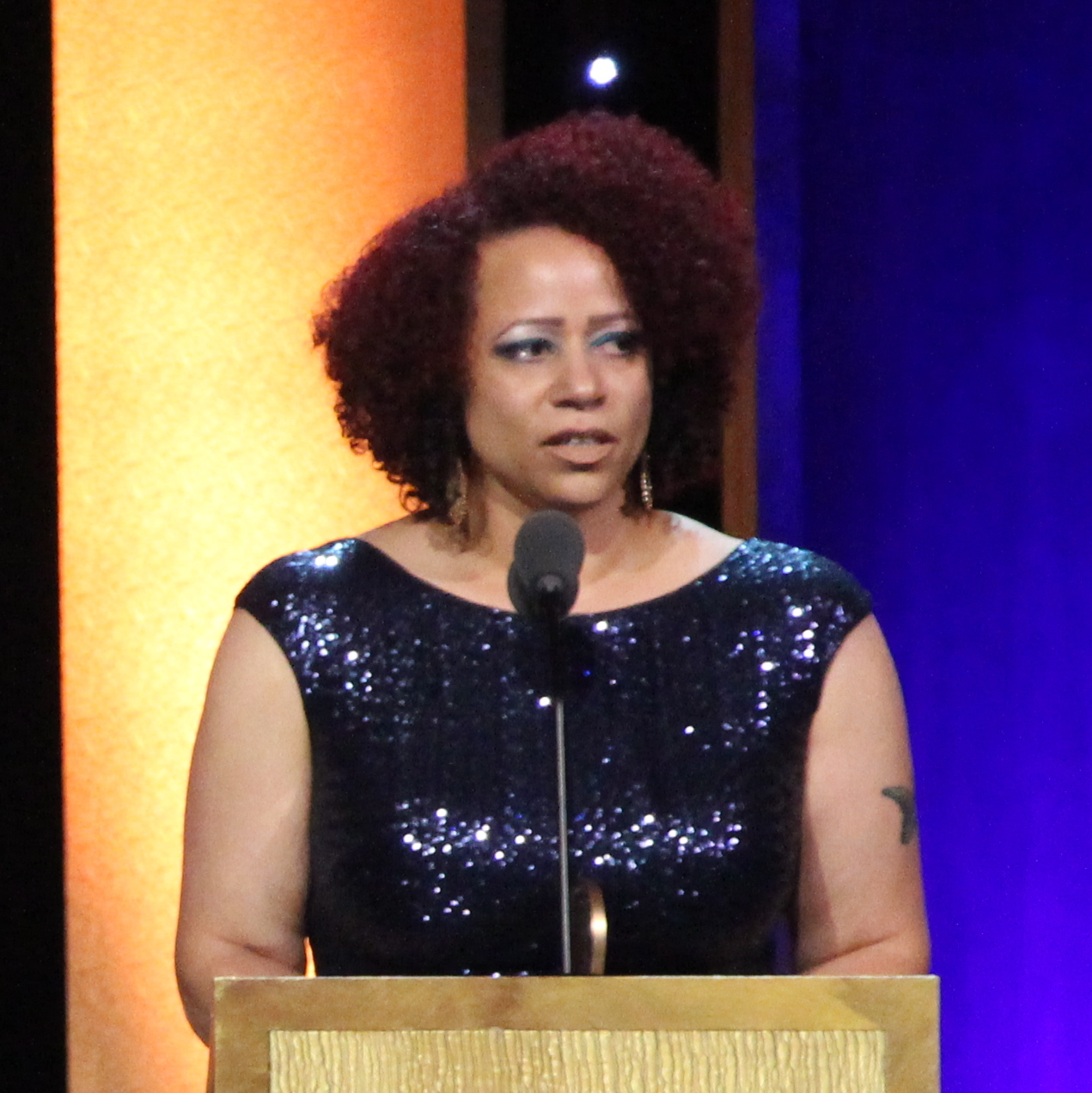
- Nikole Hannah-Jones is a journalist and historian famous for the 1619 Project and the idea that America wasn’t a democracy until Black Americans made it one. She won a Pulitzer Prize in 2022. The award cited her “sweeping, provocative and personal essay for the ground-breaking 1619 Project, which seeks to place the enslavement of Africans at the center of America’s story, prompting public conversation about the nation’s founding and evolution.” The project was criticized by some historians for its assertion that “one of the primary reasons the colonists decided to declare their independence from Britain was because they wanted to protect the institution of slavery.”
General historical issues
- American Historical Association standards of professional conduct
defines history as “the never-ending process whereby people seek to understand the past and its many meanings.”