
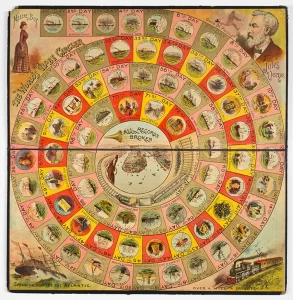
Nellie Bly game, NY World, 1890. Public Domain. For a larger version of the game board, click on the image.
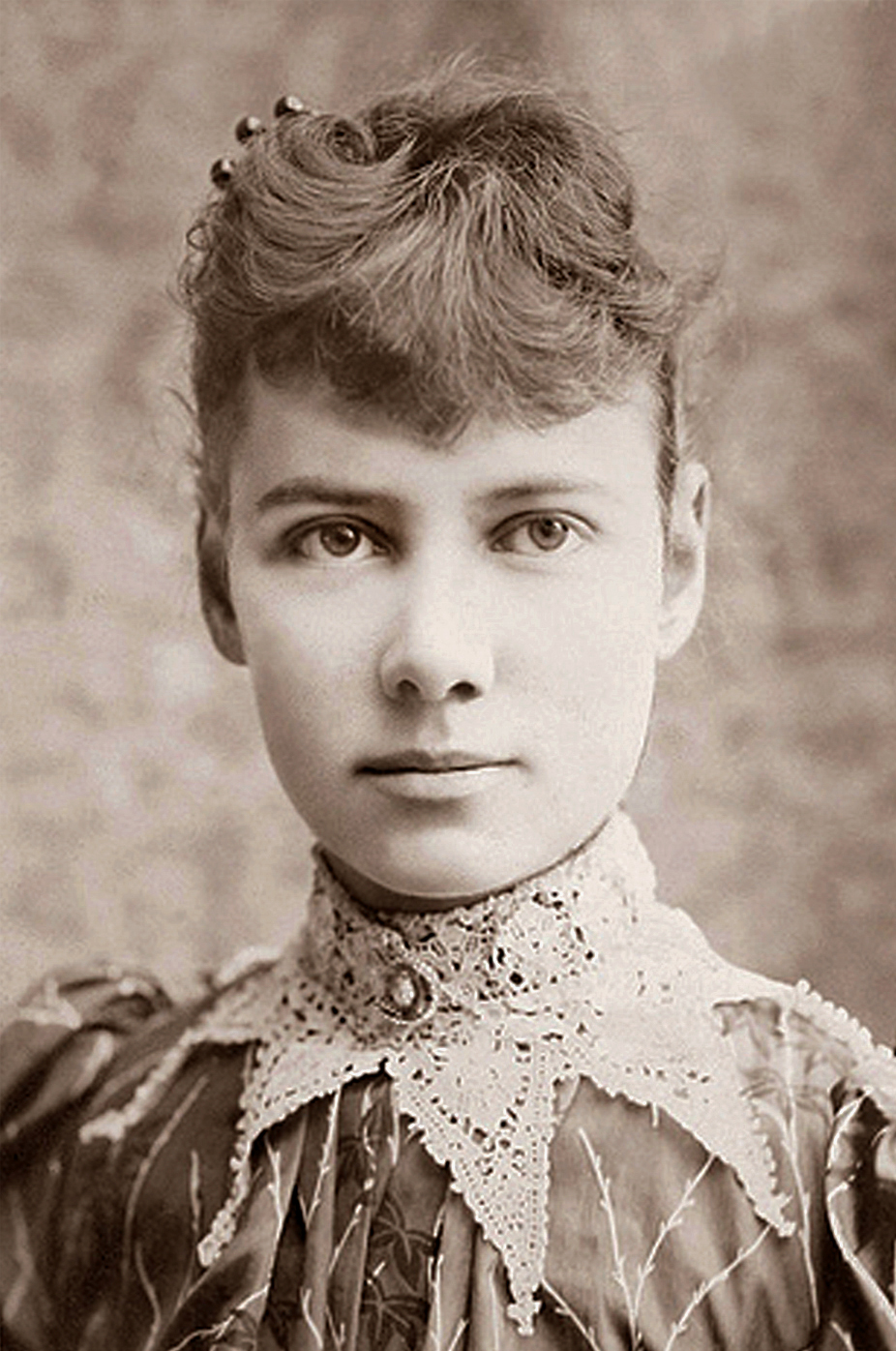
Sleep was eluding star reporter Nelly Bly. At 3 a.m. on a Monday morning in 1889, Bly worried that she would have to pitch story ideas to editors at Joseph Pulitzer’s New York World in only a few hours. “At last, tired, and provoked at my slowness in finding a subject, something for the week’s work, I thought fretfully: ‘I wish I was at the other end of the earth!’ … And why not? The thought came: I need a vacation; why not take a trip around the world?” The idea was to beat the fictional record of Jules Verne’s character, Phileas Fogg, from the novel Around the World in 80 Days, published in 1873. At first, there were the usual objections. She was a vulnerable woman. She would have to carry too much luggage. It would take too long to get started.
“I can start this minute,” she insisted. She left November 14, 1889, and, after a quick visit with Verne in France, she was on the other side of the world.
The trip turned into a sensation, as Pulitzer’s World newspaper printed each telegraphic dispatch with extensive maps and descriptions of the countries she visited. She returned to New York, to a tumultuous welcome, on January 25, 1890, having made the tour in seventy- two days. Historian Brooke Kroeger said Bly was “an exemplar of an age when American women were vigorously asserting their right— indeed, their need— to shape history itself.”
How to play the NELLIE BLY game
 The Nellie Bly game was first published in the New York World newspaper on Jan. 26, 1890, the day after she returned to New York. It’s a simple game where players take turns rolling the dice to see who can win the 73-day race. It can be played as one turn per class period or several turns.
Its fun for history students to compete and to share what was known in 1890 about the people, countries and ideas that were the backdrop of Bly’s dramatic race.
Instructors: To get started, decide on a way to keep score (We used a Google Doc so everyone could keep their place from week to week).
To keep the game going, have students look up the place or people where their markers land. They may need to describe Jules Verne, or locate Brindisi and its geographic significance, or explain which modern nation was once called Ceylon.
Students: Be prepared to describe in class the location and people involved in the spaces where you land. This is meant as a casual exercise rather than a formal research prompt. However, some serious questions may come up, such as:
- Why did Jules Verne and other fiction writers from his era write about exploration as if people needed to learn more about geography? Can you think of other examples from the era where adventure stories were packed with educational information?
- What features of New York city can you identify in the center of the Bly game?
- How did Nellie Bly enhance the perception of women as capable, self-sufficient people?
- Was Nellie Bly already established as a journalist before she went on her round-the-world voyage?
- Were there other reporters like Nellie Bly at the time?
More Resources
- The New York Historical Society has more information about the game itself.
- The American Antiquarian Society (Philadelphia) has more information about Nellie Bly’s race around the world.
- Public Broadcasting Service produced a documentary about Nellie Bly. Some clips from the documentary are available here