
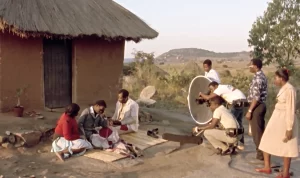
Distress Signals, a 1990 Canadian documentary, profiled Zimbabwe television director Ramius Musasa and his crew producing Know Your Roots, a drama about coping with modernization. Courtesy of John Walker Productions.
As videotape and satellites made the world’s media more accessible in the 1980s, the process was increasingly seen as “globalization” in the style of the Western commercial model of media—a model that had little to do with development.
American television producers claimed at the time that they were creating a better world by subsidizing international broadcasting. For example, an episode of an entertaining American TV show like Miami Vice would cost $1.3 million to produce, which would easily be recouped in the US. However, it might also sell to a French television network for $60,000 per episode and to a developing nation’s TV network for $500 per episode.
This was charity, the Americans said. “If they hadn’t had the American product, how would they have filled the hours?” MCA International President Colin Davis asked in a 1990 documentary video about the global communications debate, Distress Signals.
The problem with Davis’ view, said documentary producer John Walker, is that American television shows like Miami Vice do not speak to the issues or interests of people in the global South. The importance of developing TV programming that actually does speak to those interests represents something far greater than buying a second-hand cop show dumped on the global television market (Distress Signals, 1990).
Despite the expense, media development continued, slowly. The IPDC carried on, without much US involvement. One outstanding series, Africa: Search for Common Ground (1998), was created in 1998 with the idea of getting beyond false images of chaos, crisis, and despair.
“As technological advances increase the influential power of the media, these one-dimensional images serve to marginalize African affairs and characterize Africans as incapable of solving their own problems,” said a US Agency for International Development report about the documentary. “In an attempt to counter these images, Common Ground Productions sought to uncover a more comprehensive picture of the continent—one which captures the positive signs of growth and triumph across the continent without diminishing the complexity of the African experience” (Mark, 1998).
Tech change drives media development
Despite bitter policy debates and these few useful efforts, it was technological change that eventually drove most of the global communications revolution. The emergence of new cinema in Africa, India, and Latin America owed less to international aid agencies and far more to digital technology that dropped production and editing costs 100-fold. The cost of broadcasting exchanges also dropped dramatically, in some cases making satellite or telecomm links obsolte.
The Caribbean News Agency (CANA), founded in 1975, had been paying $230,000 per year for leased phone lines in the 1980s and 90s to enable “round robin” news exchanges between radio stations in the islands. After the emergence of digital audio technology in the late 1990s, CANA was trading MP3 audio files through the internet at no cost.
The international effort to encourage global media development did have positive outcomes. Although it did not solve many of the problems, it created an awareness of the uneven and inequitable flow of global communication. And the debate was revived in the twenty-first century when the internet opened a new frontier for communication.
UNESCO continued to point up the issues in 2003 and 2005 with the World Summits on the Information Society in Geneva and Tunis. While 175 countries and thousands of people took part, the summits did little more than demonstrate the same major disagreements in world communication policy. Governments were not even able to agree that the Universal Declaration of Human Rights would be the basis of a summit declaration. In addition, the summits were marred by attacks on journalists and refusals to include some nongovernmental organizations critical of the human rights records of China and other countries.
The ideas and concerns of the MacBride Commission are still current, but the frame has shifted to globalization and technical standards rather than international guidance. There is also a question of whether nations are still the primary actors; some believe they have been replaced by NGOs struggling in the shadows of global communications companies.
There is still, most of all, a need to recognize communication as a function of culture. As IPS News Agency founder Roberto Savio said: “Information governed by the values of trade globalizations, such as profits, efficiency and competition, must not be put ahead of communication based on the values of the public: solidarity, justice, equality, pluralism and participation” (Tupper, 2005).