
Full text of US president John F. Kennedy’s address to the American Newspaper Publishers Association, April 20, 1961
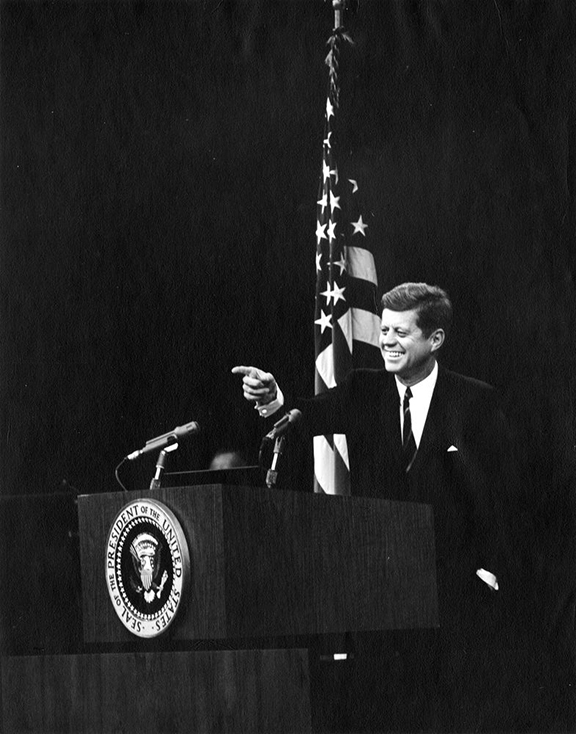
AR7595-B 20 November 1962
Press Conference, State Department Auditorium, 6:00PM.
Please credit “Abbie Rowe. White House Photographs. John F. Kennedy Presidential Library and Museum, Boston”
“You may remember that in 1851 the New York Herald Tribune under the sponsorship and publishing of Horace Greeley, employed as its London correspondent an obscure journalist by the name of Karl Marx. We are told that foreign correspondent Marx, stone broke, and with a family ill and undernourished, constantly appealed to Greeley and managing editor Charles Dana for an increase in his munificent salary of $5 per installment, a salary which he and Engels ungratefully labeled as the “lousiest petty bourgeois cheating.” But when all his financial appeals were refused, Marx looked around for other means of livelihood and fame, eventually terminating his relationship with the Tribune and devoting his talents full time to the cause that would bequeath the world the seeds of Leninism, Stalinism, revolution and the cold war. If only this capitalistic New York newspaper had treated him more kindly; if only Marx had remained a foreign correspondent, history might have been different. And I hope all publishers will bear this lesson in mind the next time they receive a poverty-stricken appeal for a small increase in the expense account from an obscure newspaper man…”
” No President should fear public scrutiny of his program. For from that scrutiny comes understanding; and from that understanding comes support or opposition. And both are necessary. I am not asking your newspapers to support the Administration, but I am asking your help in the tremendous task of informing and alerting the American people. For I have complete confidence in the response and dedication of our citizens whenever they are fully informed.
“I not only could not stifle controversy among your readers — I welcome it. This Administration intends to be candid about its errors; for as a wise man once said: “An error does not become a mistake until you refuse to correct it.” We intend to accept full responsibility for our errors; and we expect you to point them out when we miss them.
“Without debate, without criticism, no Administration and no country can succeed — and no republic can survive. That is why the Athenian lawmaker Solon decreed it a crime for any citizen to shrink from controversy. And that is why our press was protected by the First Amendment — the only business in America specifically protected by the Constitution- -not primarily to amuse and entertain, not to emphasize the trivial and the sentimental, not to simply “give the public what it wants” — but to inform, to arouse, to reflect, to state our dangers and our opportunities, to indicate our crises and our choices, to lead, mold, educate and sometimes even anger public opinion.
This means greater coverage and analysis of international news — for it is no longer far away and foreign but close at hand and local. It means greater attention to improved understanding of the news as well as improved transmission. And it means, finally, that government at all levels, must meet its obligation to provide you with the fullest possible information outside the narrowest limits of national security — and we intend to do it.
It was early in the Seventeenth Century that Francis Bacon remarked on three recent inventions already transforming the world: the compass, gunpowder and the printing press. Now the links between the nations first forged by the compass have made us all citizens of the world, the hopes and threats of one becoming the hopes and threats of us all. In that one world’s efforts to live together, the evolution of gunpowder to its ultimate limit has warned mankind of the terrible consequences of failure.
And so it is to the printing press — to the recorder of man’s deeds, the keeper of his conscience, the courier of his news — that we look for strength and assistance, confident that with your help man will be what he was born to be: free and independent.