Author Archives: Bill

First Amendment Updates, 2025-26

FCC’s  Brendan  Carr

PBS defunding reversed — March 31 — A federal judge has permanently blocked the Trump  administration’s  federal funding cuts for National Public Radio and the Public Broadcasting Service.

Pentagon press policy unconstitutional — March 20, 2026 — A federal judge struck down the    Pentagon’s prior restraint press policy from September 2025,  saying that it violated the First and Fifth Amendments to the Constitution.

More ThreatsMarch 14-15 2026  President Trump and FCC chair Brendan Carr threaten to revoke broadcast licenses over what they claim to be  incorrect news items.  This followed a Trump social media post March 14  and March 15  claiming that damage reports from a minor incident were deliberately distorted. “Their terrible reporting is the exact opposite of the actual facts!” Trump wrote. “They are truly sick and demented people that have no idea the damage they cause the United States of America.”  (Note: First Amendment advocates have repeatedly warned that Trump’s “rage rhetoric” is dangerous. )  

Is it constitutional to threaten revocation of licenses?  In NRA v Vullo, a unanimous May 30, 2024 Supreme Court decision, Justice Sotomayor wrote for the court:

A government entity’s threat of invoking legal sanctions and other means of coercion against a third party  to achieve the suppression of disfavored speech violates the First Amendment… Government officials cannot attempt to coerce private parties in order to punish or suppress views that the government disfavors.  .
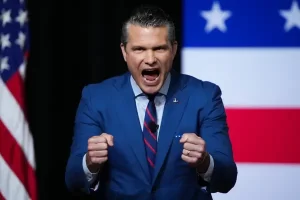
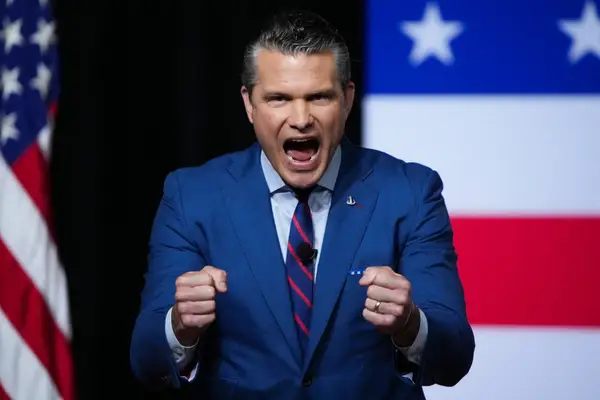
Pete Hegseth was not flattered. AFP / Pool photo.

Unflattering photos — March 10 — Defense secretary Pete Hegseth ordered photojournalists barred from Pentagon press conferences. Sources said Hegseth was upset over “unflattering” photos, although its difficult to understand which  might have flattered him in the first place.

Deaths of soldiers only reported to make Trump look bad — March 4 — During a press briefing on March 4, Pete Hegseth claimed that the press was only reporting on the deaths of American soldiers in order to “make the president look bad.”  Despite his time as a Fox news anchor, Hegseth clearly does not understand the role of the media.

Interview blockedFeb 17, 2026 An interview with Texas democratic candidate for senate James Talarico, was blocked from the CBS broadcast of the Late Show with Stephen Colbert under (supposedly) the Equal Time Rule.

Threats — Jan 17, 2026 — The White House threatens a lawsuit against CBS if it edits a  Trump interview.  White House press secretary Karoline Leavitt told a CBS producer that the network news program had to run a full interview with Donald Trump, without edits, or CBS would be sued.  “Not long ago, the notion of a White House press secretary’s casually threatening a lawsuit if a journalist does not obey her orders would be shocking,” the New York Times said in a news article about the threat. “But Mr. Trump has made abundantly clear that he is serious about pursuing legal or regulatory action against media outlets whose coverage displeases him.”

The litigation Trump threatens is nearly always frivolous, capricious, and lacking an any serious merit whatsoever. When not “settled” out of court by media organizations under Justice Department pressure for merger approvals, the suits are thrown out of court.  This is an entirely abnormal and unprecedented use of executive power to oppose the spirit and letter of the First Amendment.

Reporter’s home searched — Jan 13, 2026 — FBI agents executed a search warrant on Washington Post reporter Hannah Natanson, whose beat included a wave of firings and layoff of federal workers. The search may well be illegal under the Privacy Protection Act of 1980.  UPDATE: Feb. 24 — The judge who approved the search warrant chastised prosecutors who did not tell him about the Privacy Protection Act of 1980,  a federal law that limits ex-parte search warrants of newsrooms or reporters working files. Continue reading

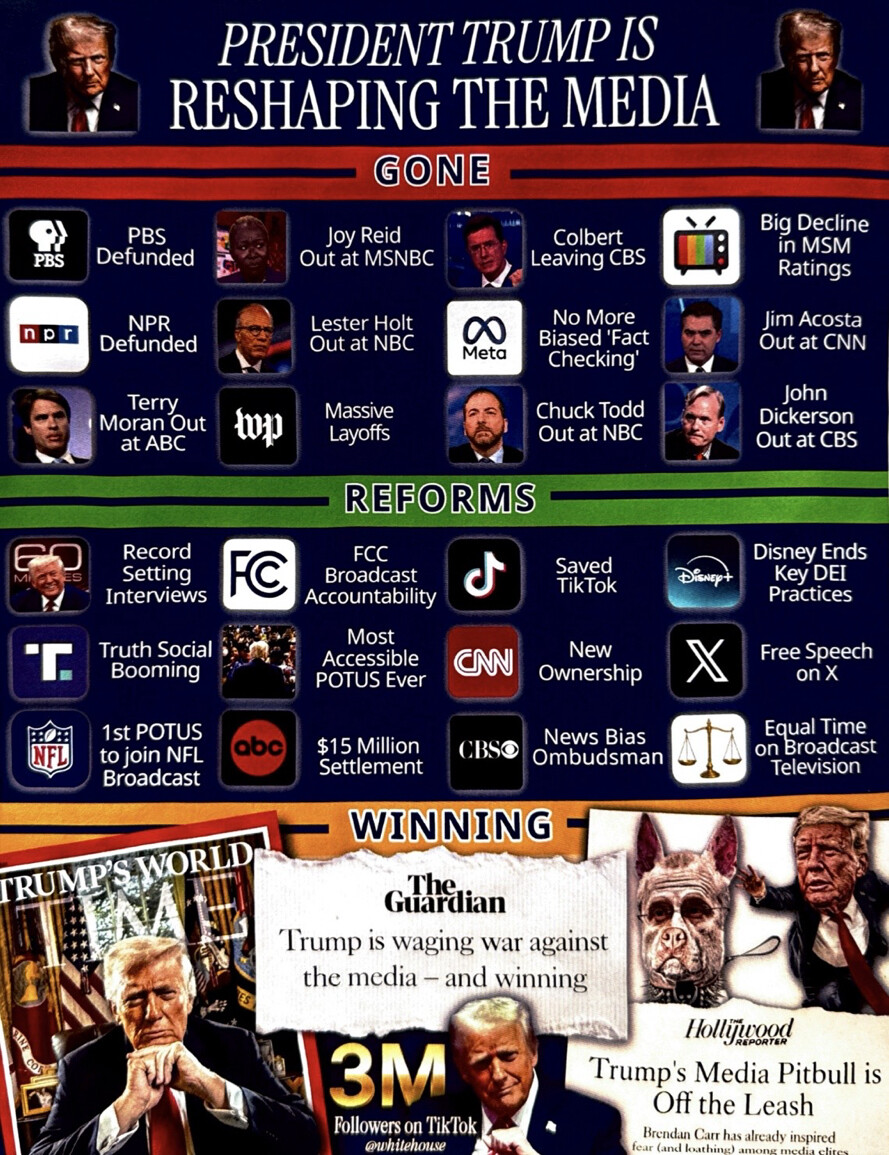
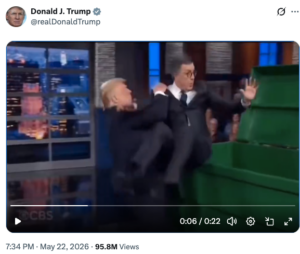
Trump brags he’s “reshaping the media”

This astonishing admission of government interference with the press was posted on Trump’s social media account. Trump is openly violating the First Amendment. See @realDonaldTrump March 14, 2026.

More censorship for the Late Show


In a new interpretation of longstanding rules  released Jan. 21, 2026,  the Trump administration’s Federal Communications Commission said that Section 315  “Equal Time Rule”  requirements for news talk programs are in effect unless there is an exemption, which Stephen Colbert does not have.

Under the rule, broadcast media must provide equal time for all politicians running for the same office. If an interview is aired with a democratic candidate for an office,  a similar interview with republican and independent candidates  must also be aired.

The rule was widely interpreted as applying only to advertising, since strict application of US Title 47 Section 315 to news interviews on talk shows would create editorial chaos.

That’s why the law exempts bona-fine news programs and talk shows from the rule. Historically, only a very few talk shows have applied for exemptions;  apparently, the last two were  Anderson Cooper in 2011 and a California talk show in 2006.  These two cases were  considered as examples of a de-facto blanket rule that left talk show editorial decisions to the broadcasters.

What’s new is that now in 2026,  the Trump FCC is changing the rule’s interpretation and applying pressure on CBS:

Concerns have been raised that the industry has taken the Media Bureau’s 2006 staff-level decision to mean that the interview portion of all arguably similar entertainment programs— whether late night or daytime—are exempted from the section 315 equal opportunities requirement under a bona fide news exemption. This is not the case. As noted above, these decisions are fact specific and the exemptions are limited to the program that was the subject of the request.

Attorneys with the CBS network told the Late Show with Stephen Colbert that they were running afoul of the law simply by having politicians on the show.  Colbert says that CBS  ordered  him not to air an interview with James Talarico, a democratic candidate for a US Senate seat in Texas.  So the interview was placed on YouTube, which does not fall under the same broadcast media regulations.

Anna M. Gomez, an FCC commissioner appointed by President Joe Biden in 2023, condemned the censorship of the Colbert show  “This is yet another troubling example of corporate capitulation in the face of this Administration’s broader campaign to censor and control speech,” Gomez said.

Republican-appointed FCC commissioners Brendan Carr and Olivia Trusty supported the new interpretation of the rules.

How the First Amendment protects you

By Ray Brescia 
Associate Dean, Albany Law School, via The Conversation,

Imagine a protest outside the funeral of a popular political leader, with some of the protesters celebrating the death and holding signs that say things like “God Hates the USA/Thank God for 9/11,” “America is Doomed” and “Don’t Pray for the USA.”

No matter the political leanings of that leader, most Americans would probably abhor such a protest and those signs. Why would (we) tolerate such activities, no matter how distasteful? The First Amendment.

The situation described above is taken from an actual protest, though it did not involve the funeral of a political figure. Instead, members of the Westboro Baptist Church protested outside the funeral of Marine Lance Cpl. Matthew Snyder, a U.S. service member killed in Iraq.

Through demonstrations like this, members of this group were conveying their belief that the U.S. is overly tolerant of those they perceive as sinners, especially people from the LGBTQ community, and that the death of U.S. soldiers should be recognized as divine retribution for such sinfulness.

Snyder’s family sued for intentional infliction of emotional distress, among other claims. A jury issued a US$5 million jury award in favor of the family of the deceased service member. But in a nearly unanimous decision issued in 2011, the U.S. Supreme Court found that the First Amendment insulated the protesters from such a judgment.

This holding is particularly instructive today.

Continue reading

Press freedom under siege – Pelosi

Former Speaker of the House Nancy Pelosi said on Feb 4, 2026, that press freedom is under siege in the US.  Rep. Pelosi’s remarks were given at the annual dinner of the Washington Press Club.

Do EU regs threaten American speech?

Rep. Pramila Jayapal (D-WA)

To oppose EU hate speech laws and other digital media regulations, the House Judiciary Committee brought in three minor European figures who testified in support of  legislation that would expand US First Amendment freedoms into Europe.

The  Feb. 4, 2026 hearing, “Europe’s Threat to American Speech and Innovation: Part II,” highlighted Europe’s supposed “online censorship laws,” such as the European Union’s (EU) Digital Services Act (DSA) and the United Kingdom’s (UK) Online Safety Act (OSA).

According to the Republican-led committee, these European laws “threaten Americans’ right to speak freely online in the United States.”

Of course, the vast majority of European officials don’s support the Republican viewpoint and have argued that opposing their regulations undercuts their national sovereignty.

Democrats in the sharply divided committee also disagreed, saying we can’t compare minor inconveniences in EU law to the harsh treatment of citizens and press in Minnesota.

“We should focus on our First Amendment violations right here at home instead of pulling in people from other countries,” said Rep. Pramila Jayapal (D-WA) “That’s what this committee should be investigating.”

Continue reading

New ideas for 2026

How can we rebuild a culture of free expression?

As America approaches its 250th anniversary, free speech and press freedom face unprecedented threats from campus censorship, social media content moderation, and government pressure campaigns. From college students afraid to voice opinions in class to journalists facing investigations, the First Amendment foundations of American democracy are under multiple threats in ways the Founders never imagined.

Stuart N. Brotman is Professor of Media Management and Law and Beaman Professor of Journalism and Electronic Media at the University of Tennessee, Knoxville.

“It was intended to be amended”  A History of the U.S. Constitution by Jill Lepore is a 2025 book about the origins and theories of constitutional law. She argues that the framers intended it to be a living document, not a static one (as “originalists” believe). Also, amending the constitution should be easier in order to reduce the risk of political violence and judicial overreach.   

Jill Lepore is an historian and journalist. She is the David Woods Kemper ’41 Professor of American History at Harvard University and a staff writer at The New Yorker.

Trump tanks Canadian trade talks over ads

Oct. 24, 2025  — President Trump announced he has ended trade negotiations with Canada in direct response to a television ad that opposed U.S. tariffs. The  ad began airing on CBC and major US networks around Oct. 14 was produced by the province of Ontario. The ad uses video from the Radio Address to the Nation on Free and Fair Trade given by president Ronald Reagan on April 25, 1987.  Trump claimed the ad was  “fake”  and somehow designed to influence American courts.

The Ronal Reagan Presidential Library posted a message on X / Twitter claiming that the ad “misrepresents” the Reagan position. However,  a video posted by the Reagan library shows plainly that there is no inconsistency. Reagan supported free trade policies in the 1980s and the Republican Party was long was known as “the party of free trade.

The Reagan library also said that the government of  Ontario “did not seek or receive permission to use and edit the remarks.”  However, there is no requirement for anyone to seek permission to use  publications in the public domain. All official acts of the US government, including presidential speeches, are in the public domain after short (5 to 12 year) processing time limits have been reached.  The Reagan library acknowledges this in its statement on the Presidential Records Act.  And the Reagan library has itself released these records to the public on its YouTube channel).  Continue reading

Trump & the press: John Oliver’s take