Author Archives: Bill

Facebook faces antitrust case

Perspectives on Trump media pressure

Put Colbert to sleep — Dec 24 — In a social media post, Donald Trump said that comedian Stephen Colbert is a “pathetic train wreck” and that CBS should “put him to sleep”  He also said: “If Network NEWSCASTS, and their Late Night Shows, are almost 100% Negative to President Donald J. Trump, MAGA, and the Republican Party, shouldn’t their very valuable Broadcast Licenses be terminated? I say, YES!”

Another comedian bothers Trump  — Nov 17 —  Trump and FCC chair Carr called for comedian Seth Meyers to be fired by the National Broadcasting Company. “NBC’s Seth Meyers is suffering from an incurable case of Trump Derangement Syndrome (TDS),” Trump posted on Truth Social on Nov. 15.

Demeaning reporters — Nov 14 — Asked about the ongoing Epstein scandal, Trump turned on a female reporter and responded “Quiet, Piggy.”

Suing BBC — Nov 14 – President Trump said he was considering a libel suit against the British Broadcasting Corp. for up to $5 billion after it spliced together separate excerpts of a speech on January 6, 2021, when his supporters stormed the Capitol. Trump claimed the edit created the impression he had called for violence. BBC apologized but said it would fight any legal action.

Not taking the Pentagon press pledge — Oct 14 — News organizations have refused the Trump administration’s offer to allow them continued credentials at the Pentagon in exchange for a written pledge to only report “authorized” official information approved by the Pentagon press office.  Organizations refusing this unprecedented new policy include the Associated Press, New York Times, CNN, Reuters, Fox and Newsmax.  In addition to refusing the policy,  NPR defense reporter Tom Bowman is turning in his press credentials.   OneAmerica News is the only outlet that has agreed to the new Pentagon rules. The Poynter Institute provides a breakdown on the policy and its critics. Update from the Reporter’s Committee for Freedom of the Press:  The New York Times filed a lawsuit  in the first week of December 2025 claiming that the new Pentagon policy violates the First Amendment. The RCFP has a short summary and explainer of the legal theories advanced by the Gray Lady.

Kimmel show cancelled — Sept. 17 — Pressure from the Federal Communications Commission led ABC to cancel the Jimmy Kimmel show.  Kimmel faced criticism over remarks about the politics of the man who is accused of killing conservative activist Charlie Kirk.  ABC / Disney relented after fans objected, and Kimmel returned Sept. 23 with a moving  defense of free speech.

Trump calls for FCC to revoke broadcast network licenses — Aug 25, 2025 – President Donald Trump reiterated a long-running push for the Federal Communications Commission to revoke station licenses of two major U.S. broadcasters and charge them for using the public airwaves, as he criticized their news programming.  Trump suggested late on Sunday on social media that Disney-owned ABC  and Comcast-owned  NBC are biased and mostly air “bad stories” about him, and as a result, should, “according to many, have their licenses revoked by the FCC. I would be totally in favor of that because they are so biased and untruthful.”

Colbert show cancelled — July 17 — CBS decided to cancel Late Night with Stephen Colbert a few days after Colbert criticized CBS’s parent company, Paramount Global, for paying $16 million to settle a lawsuit filed by then-presidential candidate Donald Trump, who claimed the network interfered in the 2024 election by editing a 60 Minutes interview with his opponent, Kamala Harris. (PBS)

Continue reading

2024 Supreme Court comm cases

The court heard four major communications cases in the 2023-24 term and reported opinions in the spring and summer of 2024.

Moody v Netchoice involved state  government attempts to stop “censorship” by social media companies.  At issue was whether the First Amendment allows a   Florida or Texas to require that social-media companies host third-party communications.  The Florida and Texas state laws were intended to ensure that conservative voices were not censored by big tech companies, and the laws were premised on the idea that social media are common carriers.

In a rare unanimous decision, the court said that social media companies are not common carriers but rather private media companies and that they could not be regulated by state governments.  A state government “cannot get its way just by asserting an interest in better balancing the marketplace of ideas,” said the Supreme Court opinion.  “Whatever the challenges of applying the Constitution to ever-advancing technology, the basic principles (of the First Amendment) do not vary.”

Among a long list of cases supporting Netchoice are  Republican National Committee v Google, which was dismissed in favor of Google on Aug. 24, 2023.  The RNC alleged that Google had been intentionally misdirecting its emails to Gmail users’ spam folders at the end of each month “to secretly suppress the political speech and income of one major political party.”  The court said the RNC had not proven bad faith and  that, in any event, that would have been protected by section 230 of the CDA. Another similar case  protecting the right of private companies to free speech was YouTube v Prager, 2020.

O’Connor-Ratcliff v. Garnier. When a public official blocks someone from their social media personal, unofficial social media account, is that an act of censorship prohibited by the First Amendment?  The court ruled that public officials who post about topics relating to their work on their personal social media accounts ARE acting for the government, and therefore ARE violating the First Amendment when they block their critics.

Vidal v. Elster,   Does the the refusal to register a trademark under 15 U.S.C. § 1052(c) violate the First Amendment when the mark contains criticism of a government official or public figure? The proposed trademark in question was “Trump too small.”  The court said that the Lanham Act prohibits the registration of a trademark that identifies a particular living individual, unless that individual agrees.  Refusal to register the trademark does not violate the First Amendment.

Murthy v. Missouri  Can the federal government attempt to influence private social media companies’ content-moderation decisions? Is that a state action that violates First Amendment rights? The state of Missouri claimed that US Surgeon General Murthy’s attempts to influence social media about “anti-vax”  rhetoric was a violation.  The Supreme Court disagreed.

MORE: See the SCOTUS Blog 

Climate scientist wins libel suit

US climate scientist Michael Mann won his longstanding libel suit against right-wing climate deniers on Feb. 8, 2024, with a jury award of $1 million in puntive damages. 

The lawsuit began in 2012, when Mann accused Rand Simberg, a former adjunct scholar at the Competitive Enterprise Institute, and Mark Steyn, a contributor to National Review, of defamation when they alleged that his work was so fraudulent it was like child molestation.     

Scientists see  the verdict “as a warning to those who attack scientists working in controversial fields, including climate science and public health,” according to  Nature magazine.   

The question in libel is whether the defendant knowingly published a falsehood or acted in reckless disregard for the truth.  In testimony,  Simberg and Steyn both insisted that they do not agree with Mann’s climate science, so the question was whether or not they were reckless.

“The trial transported observers back to 2012, the heyday of the blogosphere and an era of rancorous polemics over the existence of global warming, what the psychology researcher and climate misinformation blogger John Cook called “a feral time,” said a New York Times article.

A federal court opinion from 2016  located here: Competitive Enterprise Institute v Mann.   The 2024 decision is not yet on Nexis, SCOTUS blog, or other legal sources. Also see Alito Dissent from denial of cert, 2021.


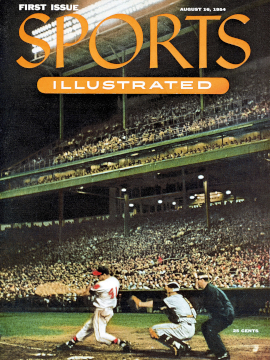
Sports Illustrated cover

Sports Illustrated first cover Aug. 15, 1954

By Bill Kovarik

Sports Illustrated — once the beloved icon of sports news and photography — has been sidelined for financial irregularities and technical fouls. It probably won’t be back.

The fouls involved articles scraped up through artificial intelligence bots – an ethical lapse which came to light in November, 2023. Worse, the magazine tried to cover it up with AI portraits of the supposed authors. The ruse was quickly spotted and the editor was fired.

As advertisers began pulling out, the remaining editors and management faced increasing financial trouble and then, on Jan. 5, 2024, defaulted on regular quarterly payment to its owners, Authentic Brands Group. Two weeks later, ABG terminated the licensing agreement and laid off most of the reporting staff.

So, let’s pause for a moment of silent reflection, in recognition that another great institution is passing us by, headed for the intellectual property bone yards, where its icons will be recycled to brand products like designer swimsuits and tennis shoes.

Sports Illustrated was founded in 1954 by Henry Luce of the Time-Life group to compete with two of the major sports magazines of the time — Sport (founded 1946) and the venerable Sporting News (founded 1886). Back then, people thought Luce was crazy to invest in a “jockstrap” magazine, but his timing was good.

Illustrated magazines were filling the consumer demand for high quality visual experiences while the dominant media — radio and early television — offered audiences only low visual definition. Sports Illustrated also presented better quality journalism and photography than was possible in daily newspapers at the time, and Luce managed to keep all his magazines a step ahead of the competition.

In the 1950s and 60s — a time when politics was America’s most dangerous occupation — Sports Illustrated occupied center field by raising the tone of sports news. Along with sports that were already well covered, like boxing and baseball, Sports Illustrated opened tennis, golf, football and basketball to greater public participation.

Some of its editorial innovations are still well known, such as the athlete of the year and the annual swimsuit issue. Making the cover of Sports Illustrated was, for an athlete, a lot like a Nobel Prize for a scientist.

However, by the end of the twentieth century, the business of magazine and newspaper publishing fractured under competitive pressures from cable, streaming and internet publications. Advertising and circulation declined, and so did Sports Illustrated, despite valiant attempts to save it.

The magazine was sold during the Time-Warner breakup in 2018 and, after changing hands, was picked up by Authentic Brands Group, which specializes in

franchises like Reebok shoes, clothing brands like Juicy Couture, and commercial celebrity names like Elvis Presley and Marilyn Monroe.

ABG will profit from the Sports Illustrated photo archives and the famous swimsuit editions, if nothing else. But the chances that Sports Illustrated will return from the elephant graveyard of news magazines are probably about the same as those of Sport (d. 2000), Sporting News (d. 2012), or for that matter, general photo magazines like Look (d. 1971) or Life (d. 20 00).

Its not only that the genre is no longer profitable, or that if you want to make a small fortune in publishing, you have to start with a big one.

No.

It’s that the world has moved on. Deadspin, theAthletic, network media like ESPN, and media from individual franchises and conferences have all taken center field now. Magazines of all kinds are long gone.

One reason why all this matters more than, say, shifts in seasonal produce or fashions in furniture, is that print journalism was a quality element in a bundle of services that have come unglued.

Thoughtful writing and brilliant photography no longer have solid financial support from middle America.  Magazines like Sports Illustrated were lost on the amusement park midway and drained of life by the digital-industrial information complex.

There is no fixing the loss of magazines, but there are ways to rebuild the media. Repealing Section 230 would be a start in the US.  Adopting legislation like Canada’s Online News Act and Australia’s News Media and Digital Platforms Mandatory Bargaining Code would be helpful. In Europe, the Digital Services Act is expected to restrain Big Tech and new cross border journalism initiatives will help stabilize financing for some publications.

Recent reform proposals in the US include the Local Journalism Sustainability Act of 2021, 2022 and 2023.  While the act has attracted bipartisan support, it remains in committee while larger antitrust issues get sorted out in US v GoogleUS v Apple,   issues with Microsoft, and US v Meta.

Welcome, Mickey, to Public Domainland

Public domain is a good place, and I think you and Minnie are going to like it there.   You  are  moving into a terrific neighborhood.  There’s Paul Bunyan and Tom Sawyer next door. And across the pond in Britain, you’ll see Alice in Wonderland,  King Arthur and Robin Hood.  Across the English channel, you see the Little Mermaid and Snow White and Hansel and  Gretel.  A little further south, there’s Aladdin and Ali Babba, and further south, across the Sahara, there’s Anansi, Brer rabbit and Fumo Liongo. 

So, it’s a small world after all.  

Now I know there was a lot of controversy about the way you had to stick with Disney for an extra 20 years because of  the Sony Bono Copyright Extension Act.  The legal team from Harvard, you know, Eric Eldred and Larry Lessig and those guys, tried to appeal the act. They told the courts that they were worried the “extension” would be extended again, which would lead to an unconstitutional situation with perpetual copyrights. But in 2003 the Supreme Court said that was the business of Congress, and gave the  issue a judicial pass ( in Eldred v Ashcroft). 

But now its 2024,  and as it turns out, you didn’t break the Constitution, Mickey. It’s a pretty strong contract, and some of us were probably too worried. Twenty years went by, and now you and Minnie are packing your bags and sailing off to live among your old friends.

It’s not really retirement, you’ll be glad to hear. There are all kinds of new ideas popping up around public domain figures like yourself. Yes, its true, not all of them are family-friendly, but that’s life in a free country.  The First Amendment protects the good, the bad and the ugly. Yes, I agree, there’s a little too much of those latter categories.

But you’ll always be one of the good guys, Mickey, so don’t let it get you down.  The arc of history is long, but it always arrives at justice in the end.

Here’s hoping you and Minnie enjoy your golden years.

Murthy v Missouri: Court wont block talks

The Supreme Court stopped a temporary injunction to block the Biden administration’s ongoing conversations about disinformation with social media companies on Oct. 20, 2023.

This leaves federal agencies such as the Centers for Disease Control free to attempt to influence  social media companies in order to  (as the administration says) “mitigate the hazards of online misinformation” by flagging content that violated the social media platforms’ own policies.

The states of Missouri and Louisiana have contended in Murthy v Missouri (aka Missouri v Biden) that the government “coerced, threatened, and pressured social-media platforms to censor” them, in violation of the First Amendment.  US Surgeon General Vivek Murthy is named as a defendant in the suit.  Evidence of this pressure campaign  emerged when the Twitter Files were released after Elon Musk purchased Twitter and took over company management on Oct. 27, 2022.  CNN published an article about the Twitter Files Dec. 2, 2022.

See SCOTUS Blog, Justices Allow Continued Communication
Also: FIRE Statement on Murthy v Missouri being granted cert

Recent Issues & Cases

SUPREME COURT Ends 2023 term

Several important decisions on free speech issues were handed down by the Supreme Court in the session ending June 30, 2023.   Linda Greenhouse of the New York Times notes that this session caps the triumph of what would have been an unimaginably right-wing agenda when John Roberts became Chief Justice in 2005.

Of course the big swing to religious law was Dobbs v Jackson Women’s Health Organization last year overturning Roe v Wade. This year it was 303 Creative v. Elenis — a case involving the balance between individual religious rights and public accommodations.  In 303 Creative, the Supreme Court ruled that the First Amendment prohibits the state of Colorado from forcing a website designer to work with content that conflicts with her beliefs,  such as gay marriage.

The case overturns a ban on commercial discrimination based on sexual  orientation in the 2018 decision in Masterpiece Cakeshop, Ltd. v. Colorado Civil Rights Commission.  The 303 Creative case also calls into question the 2015 case  Obergefell v. Hodges in which the court said same-sex marriages were unconstitutional. 

Justice Sonia Sotomayor’s dissenting opinion  in 303 Creative notes how far the decision crosses the line separating church and state: “Today, the court, for the first time in its history, grants a business open to the public a constitutional right to refuse to serve members of a protected class.”  This is a backlash against  people’s rights, she says. “New forms of inclusion have been met with  reactionary exclusion. This is heartbreaking. Sadly, it is also familiar. When the civil rights and women’s rights movements sought equality in public life, some public establishments refused. Some even claimed, based on sincere religious beliefs, constitutional rights to discriminate. The brave Justices who once sat on this Court decisively rejected those claims.”

Other cases this term included: 

Counterman v. Colorado   — A “true threats” case — The court said that the First Amendment limits laws that make it a crime to threaten people on the internet. In such cases, governments  must prove that the defendant acted with a culpable mental state, and not only that his words were objectively threatening. The ACLU commended the court’s decision. The case is also significant in that the  court used the New York Times v Sullivan standard, which two of the justices (Thomas and Gorsuch) would like to overturn. That now seems unlikely.

US v Hansen– Criminal solicitation —  A law against encouraging illegal immigration is constitutional, the court said, so long as it applies specifically to criminal acts and not to general ideas about immigration, which are protected under the First Amendment.

Groff v. DeJoy —  Religious accommodation — A US Postal Service delivery worker sued because he was being forced to work on Sundays.  “Title VII requires an employer that denies a religious accommodation to show that the burden of granting an accommodation would result in substantial increased costs in relation to the conduct of its particular business,” the court said.

Gonzalez v Google LLC and Twitter v Taamineh both involved the extent of protection for YouTube (Google) in automatically posting and recommending terrorist recruiting videos; they also involved the broader question of how social media and the internet are to be regulated. The SCOTUS Blog has a valuable repository of documents about the case. In both cases, the anti-terrorism law was held NOT to apply, and no decision was made about Section 230 specifically or whether or not to change the way social media and the internet are regulated.

censorship

Tic-Tok banned in 19 US states, and often on wifi at public universities, because it poses a theoretical national security risk by giving the Chinese government an ability to monitor users.

Journalists arrested in Asheville, NC, for taking video of police enforced  evictions.  They were convicted of trespassing in April, 2023, but in May, forty five  journalism and human rights organizations wrote in support of an appeal.  And on May 30, defendants Matilda Bliss and Melissa Coit filed a  motion to dismiss the charges. 

Proposals for book bans and gag orders in education have increased 250 percent in 2022 compared to 2o21, according to a study by PEN America, a non-profit free speech advocacy group.

libel

Voting machine company libel suits continue against Fox News,  One America News Network and three  Trump advisors, despite the settlement of the Dominion case on April 19, 2023.  That settlement came after Fox underestimated the strength of Dominion’s case against them, according to a May 27, 2023 NY Times article. 

The Smartmatic voting machine company is the second to bring a libel case against Fox over lies about election fraud in 2020.  Participants in that case took depositions in the fall of 2023 and say the trial might be scheduled for 2025. The allegation is that Fox and OANN aired a pattern of defamatory claims from Trump supporters about illegal  manipulation of vote counts that threw the 2020 election to Joe Biden. Depositions in advance of the trial have shown that Fox personalities did not believe the claims at the time they were aired.  One Fox personality, Tucker Carlson, was forced to resign from Fox News due (in part) to the disgrace he brought onto the network.

privacy

New European regulations on digital privacy will take effect in 2023 and 2024.  As part of the new push to improve digital privacy, the EU fined Facebook / Meta   1.2 billion Euros for privacy violations on May 22, 2023.

Digital media

State of Missouri v Biden — Federal government pressure on social media  sites is a violation of their First Amendment rights according to a sweeping decision by a federal judge. A July 4 decision in a Louisiana federal court restricted communication between the Biden administration and social media platforms — calling it “Orwellian” violation of the First Amendment. The Biden administration disagrees.  Fox headlined the issue: “Big Tech Censorship Goes to Court.

Section 230,  (of Title 47, US Code)   the social media liability shield, still stands after two similar cases Gonzalez v Google LLC and Twitter v Taamineh  by the US  Supreme Court on May 18, 2023 (noted above).

Section  230 is unpopular on both sides of the political aisles. The  Biden White House has  renewed the call for repeal of  the liability shield for social media companies in of 2022.   President Joe Biden is focused on six reform principles, which also include stronger competition  and privacy protection laws, greater transparency and more  consideration of mental health issues.

The Brookings Institution has a Guide for Conceptualizing the debate over  Section 230, such as individual harms, general harms and policy challenges.

COPYRIGHT

Dr Dre sends “cease & desist” letter to Rep. Marjory Taylor Green, who is using his music without permission on social media.

Steamboat Willie, the first Mickey Mouse cartoon, goes into the public domain (loses copyright protection) this year. What will it mean? Not that much, says Brooks Barnes in the New York Times Dec. 27.  

A  federal court in California rejected Facebook’s  “safe harbor”  Section 230 argument in a copyright case in January 2023.

Close to home 

Virginia state consumer data protection act took effect Jan 1, 2023.  Critics say it doesn’t go far enough,

Social media:   State Del. Nadarius Clark, D-Portsmouth, is proposing an investigation into the impacts of social media on Virginians.

Anti-fraternity ordinance  in Radford — Sec. 120.1-64.   entitled “Additional requirements for Greek organizations/signs”  — remains in effect, despite  Reed v Town of Gilbert, 2015, and the “content discrimination principle.”

Protests curtailed in Hong Kong

Protest in Hong Kong, March 2023, held behind “crime tape.”  (Associated Press)

According to the Hong Kong Democracy Council,  authorities have jailed more than 1,500 political prisoners since 2019, half of whom are under the age of 25. https://www.washingtonpost.com/opinions/2023/07/01/hong-kong-china-crackdown-democracy/

John Stewart and the Fox libel suit

This segment of The Problem with John Stewart was broadcast before the Fox – Dominion settlement      announced April 19, 2023.