Category Archives: Uncategorized

Press freedom under siege – Pelosi

Former Speaker of the House Nancy Pelosi said on Feb 4, 2026, that press freedom is under siege in the US.  Rep. Pelosi’s remarks were given at the annual dinner of the Washington Press Club.

Trump & the press: John Oliver’s take

Facebook faces antitrust case

2024 Supreme Court comm cases

The court heard four major communications cases in the 2023-24 term and reported opinions in the spring and summer of 2024.

Moody v Netchoice involved state  government attempts to stop “censorship” by social media companies.  At issue was whether the First Amendment allows a   Florida or Texas to require that social-media companies host third-party communications.  The Florida and Texas state laws were intended to ensure that conservative voices were not censored by big tech companies, and the laws were premised on the idea that social media are common carriers.

In a rare unanimous decision, the court said that social media companies are not common carriers but rather private media companies and that they could not be regulated by state governments.  A state government “cannot get its way just by asserting an interest in better balancing the marketplace of ideas,” said the Supreme Court opinion.  “Whatever the challenges of applying the Constitution to ever-advancing technology, the basic principles (of the First Amendment) do not vary.”

Among a long list of cases supporting Netchoice are  Republican National Committee v Google, which was dismissed in favor of Google on Aug. 24, 2023.  The RNC alleged that Google had been intentionally misdirecting its emails to Gmail users’ spam folders at the end of each month “to secretly suppress the political speech and income of one major political party.”  The court said the RNC had not proven bad faith and  that, in any event, that would have been protected by section 230 of the CDA. Another similar case  protecting the right of private companies to free speech was YouTube v Prager, 2020.

O’Connor-Ratcliff v. Garnier. When a public official blocks someone from their social media personal, unofficial social media account, is that an act of censorship prohibited by the First Amendment?  The court ruled that public officials who post about topics relating to their work on their personal social media accounts ARE acting for the government, and therefore ARE violating the First Amendment when they block their critics.

Vidal v. Elster,   Does the the refusal to register a trademark under 15 U.S.C. § 1052(c) violate the First Amendment when the mark contains criticism of a government official or public figure? The proposed trademark in question was “Trump too small.”  The court said that the Lanham Act prohibits the registration of a trademark that identifies a particular living individual, unless that individual agrees.  Refusal to register the trademark does not violate the First Amendment.

Murthy v. Missouri  Can the federal government attempt to influence private social media companies’ content-moderation decisions? Is that a state action that violates First Amendment rights? The state of Missouri claimed that US Surgeon General Murthy’s attempts to influence social media about “anti-vax”  rhetoric was a violation.  The Supreme Court disagreed.

MORE: See the SCOTUS Blog 

Sports Illustrated cover

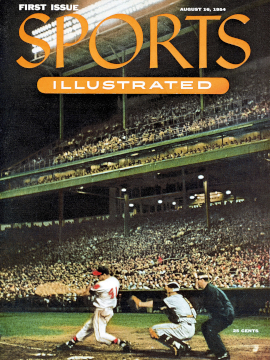
Sports Illustrated first cover Aug. 15, 1954

By Bill Kovarik

Sports Illustrated — once the beloved icon of sports news and photography — has been sidelined for financial irregularities and technical fouls. It probably won’t be back.

The fouls involved articles scraped up through artificial intelligence bots – an ethical lapse which came to light in November, 2023. Worse, the magazine tried to cover it up with AI portraits of the supposed authors. The ruse was quickly spotted and the editor was fired.

As advertisers began pulling out, the remaining editors and management faced increasing financial trouble and then, on Jan. 5, 2024, defaulted on regular quarterly payment to its owners, Authentic Brands Group. Two weeks later, ABG terminated the licensing agreement and laid off most of the reporting staff.

So, let’s pause for a moment of silent reflection, in recognition that another great institution is passing us by, headed for the intellectual property bone yards, where its icons will be recycled to brand products like designer swimsuits and tennis shoes.

Sports Illustrated was founded in 1954 by Henry Luce of the Time-Life group to compete with two of the major sports magazines of the time — Sport (founded 1946) and the venerable Sporting News (founded 1886). Back then, people thought Luce was crazy to invest in a “jockstrap” magazine, but his timing was good.

Illustrated magazines were filling the consumer demand for high quality visual experiences while the dominant media — radio and early television — offered audiences only low visual definition. Sports Illustrated also presented better quality journalism and photography than was possible in daily newspapers at the time, and Luce managed to keep all his magazines a step ahead of the competition.

In the 1950s and 60s — a time when politics was America’s most dangerous occupation — Sports Illustrated occupied center field by raising the tone of sports news. Along with sports that were already well covered, like boxing and baseball, Sports Illustrated opened tennis, golf, football and basketball to greater public participation.

Some of its editorial innovations are still well known, such as the athlete of the year and the annual swimsuit issue. Making the cover of Sports Illustrated was, for an athlete, a lot like a Nobel Prize for a scientist.

However, by the end of the twentieth century, the business of magazine and newspaper publishing fractured under competitive pressures from cable, streaming and internet publications. Advertising and circulation declined, and so did Sports Illustrated, despite valiant attempts to save it.

The magazine was sold during the Time-Warner breakup in 2018 and, after changing hands, was picked up by Authentic Brands Group, which specializes in

franchises like Reebok shoes, clothing brands like Juicy Couture, and commercial celebrity names like Elvis Presley and Marilyn Monroe.

ABG will profit from the Sports Illustrated photo archives and the famous swimsuit editions, if nothing else. But the chances that Sports Illustrated will return from the elephant graveyard of news magazines are probably about the same as those of Sport (d. 2000), Sporting News (d. 2012), or for that matter, general photo magazines like Look (d. 1971) or Life (d. 20 00).

Its not only that the genre is no longer profitable, or that if you want to make a small fortune in publishing, you have to start with a big one.

No.

It’s that the world has moved on. Deadspin, theAthletic, network media like ESPN, and media from individual franchises and conferences have all taken center field now. Magazines of all kinds are long gone.

One reason why all this matters more than, say, shifts in seasonal produce or fashions in furniture, is that print journalism was a quality element in a bundle of services that have come unglued.

Thoughtful writing and brilliant photography no longer have solid financial support from middle America.  Magazines like Sports Illustrated were lost on the amusement park midway and drained of life by the digital-industrial information complex.

There is no fixing the loss of magazines, but there are ways to rebuild the media. Repealing Section 230 would be a start in the US.  Adopting legislation like Canada’s Online News Act and Australia’s News Media and Digital Platforms Mandatory Bargaining Code would be helpful. In Europe, the Digital Services Act is expected to restrain Big Tech and new cross border journalism initiatives will help stabilize financing for some publications.

Recent reform proposals in the US include the Local Journalism Sustainability Act of 2021, 2022 and 2023.  While the act has attracted bipartisan support, it remains in committee while larger antitrust issues get sorted out in US v GoogleUS v Apple,   issues with Microsoft, and US v Meta.

Protests curtailed in Hong Kong

Protest in Hong Kong, March 2023, held behind “crime tape.”  (Associated Press)

According to the Hong Kong Democracy Council,  authorities have jailed more than 1,500 political prisoners since 2019, half of whom are under the age of 25. https://www.washingtonpost.com/opinions/2023/07/01/hong-kong-china-crackdown-democracy/

John Stewart and the Fox libel suit

This segment of The Problem with John Stewart was broadcast before the Fox – Dominion settlement      announced April 19, 2023.

Pushing back against online harrassment

Federal agencies will fight online harassment  across four main lines of effort, the Biden administration said March 3, 2023. These are prevention, survivor support, accountability, and research, according to a White House announcement.

Since its launch, the Task Force  to Address Online Harassment and Abuse has heard from hundreds of stakeholders—survivors, advocates, parents, educators, law enforcement, medical and legal professionals, and researchers—who discussed the significant harm caused by online harassment and abuse.

The Task Force is part of Biden’s call to action in the State of Union for solutions to address online safety, health, privacy, and accountability.

A Right to be Forgotten


By Bill Kovarik 
(“How a silent movie informs the current debate over the right to be forgotten.”  CC license. The Conversation

In 1915, Gabrielle Darley killed a New Orleans man who had tricked her into a life of prostitution. She was tried, acquitted of murder and within a few years was living a new life under her married name, Melvin. Then a blockbuster movie, “The Red Kimono,” splashed her sensational story across America’s silver screens.

The 1925 film used Darley’s real name and details of her life taken from transcripts of the murder trial. She sued for invasion of privacy and won.

In deciding in favor of Darley, a California court said that people have a right to rehabilitation. “We should permit [people] to continue in the path of rectitude rather than throw [them] back into a life of shame or crime,” the court said. It is a sentiment that is harder to put into practice today, when information is much more readily available. Nonetheless, policymakers and media outlets are looking at the issue.

As a scholar of media history and law, I see Darley’s story as more than an interesting slice of legal and cinematic history. Her case provides an early example of how private people struggle to escape their pasts and how the idea of privacy is linked to rehabilitation.

Continue reading

That time private US media companies stepped in to silence the falsehoods and incitements of a major public figure … in 1938

By Bill Kovarik
Published in The Conversation, Jan. 15, 2021
Creative Commons license for non-profit republication.

In speeches filled with hatred and falsehoods, a public figure attacks his enemies and calls for marches on Washington. Then, after one particularly virulent address, private media companies close down his channels of communication, prompting consternation from his supporters and calls for a code of conduct to filter out violent rhetoric.

Sound familiar? Well, this was 1938, and the individual in question was Father Charles E. Coughlin, a Nazi-sympathizing Catholic priest with unfettered access to America’s vast radio audiences. The firms silencing him were the broadcasters of the day.

As a media historian, I find more than a little similarity between the stand those stations took back then and the way Twitter, YouTube and Facebook have silenced false claims of election fraud and incitements to violence in the aftermath of the siege on the U.S. Capitol – noticeably by silencing the claims of Donald Trump and his supporters.

A radio ministry

Coughlin’s Detroit ministry had grown up with radio, and, as his sermons grew more political, he began calling President Franklin D. Roosevelt a liar, a betrayer and a double-crosser. His fierce rhetoric fueled rallies and letter-writing campaigns for a dozen right-wing causes, from banking policy to opposing Russian communism. At the height of his popularity, an estimated 30 million Americans listened to his Sunday sermons.

Continue reading