
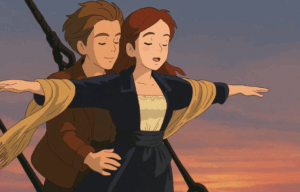
Scene from the Titanic as replicated by an AI application in the Studio Ghibli style. Click through for video.
Artificial intelligence tools were introduced to the public around 2022 and have since become popular and controversial. These tools included OpenAI ChatGPT, Midjourney, Google’s Gemini, IBM Granite, Microsoft Copilot, Adobe Firefly and many more.
Within a few years, AI tools found a wide variety of uses, including assisting with computer coding, health care, architectural design and audio / video production.
As usual, the technology was light years ahead of the law. In copyright, as we have seen, photography and “player” (automatic) pianos were not considered copyrightable until after US Supreme Court decisions in Burrow-Giles v Sarony, 1884; and White-Smith Music Publishing Co. v Apollo, 1908 (1). Video recording had to be sorted out in the Sony v. Universal City Studios, 1984 case. Audio file sharing was similarly challenged in the A&M Records v. Napster case of 2001 and the MGM Studios Inc. v. Grokster Ltd. case of 2005.
Foundations of copyright law will still apply in many cases, regardless of the technology. One of these is the doctrine of “Fair Use” (also called Fair Dealing in some countries). In the US, a four-part test is applied when someone wants to use a portion of a copyrighted work without first obtaining permission from the copyright holder. Examples of Fair Use include quoting from a book as part of a book review, or viewing videos in a classroom, or making a parody of a song. The idea of Fair Use is to balance the interests of copyright holders with the public interest. The key to a fair use parody, under Campbell v Acuff Rose (1994), is substantial transformative value.
The “Fake Drake”
 The real Aubrey Drake Graham (Wikipedia) In April of 2023, a new song featuring the voices of Drake and The Weeknd drew over fifteen million views on social media and six hundred thousand listens on Spotify. No one was more surprised by the song’s popularity than the artists it imitated through the use of AI. The song — usually called the “Fake Drake” — was taken down from streaming services with only a minor amount of damage done to the artists. Yet, as the New York Times said, the song represented something more serious. It was “a harbinger of the headaches that can occur when a new technology crosses over into the mainstream consciousness of creators and consumers before the necessary rules are in place.” The “Fake Drake” incident was the lead example in a report issued by the US Copyright Office in January, 2025. |
US COPYRIGHT OFFICE 2025 REPORT ON AI
Following a huge uptick in copyright-related AI controversy, the US Copyright Office issued a three volume report on emerging issue areas:
- REPLICATION Are digital replicas (or deep-fakes) generated by AI misappropriations under copyright law? This can include song or animation style takeoffs, or misappropriation of a person’s name-image-likeness (NIL).
- COPYRIGHTABILITY: Generally, AI media can’t be copyrighted. “If content is entirely generated by AI, it cannot be protected by copyright” because copyright protection is limited to works of human authorship. This leads to the question of how much human input is required for copyright status.
- TRAINING: When large language AI models are “trained” on books and other media scraped from the web, is that a “fair use” of that copyrighted material or is it an infringement?
REPLICATION
Replicating NILs can be a civil violation under misappropriation laws, but political satire of public figures is a First Amendment right and often re-affirmed in cases such as Hustler Magazine v Falwell, 1988. Also, parody of popular films and songs is usually protected under the “substantial transformative value” doctrine (Campbell v Acuff-Rose, 1994).
Nevertheless, the harms from unregulated replication include broad impacts on creative industries and specific harms from sexual fakes, business fraud and political disinformation. Many of the laws preventing these sorts of property related issues are found at the state level.
COPYRIGHTABILITY
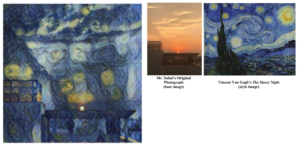
US artist Ankit Sahni used AI to combine a photo of a sunset and Van Gogh’s “Starry Night.” The US Copyright Office declined copyright registration in 2023.
Can AI images be copyrighted? Another issue involves whether the question of whether copyright covers images generated by AI. In a December, 2023 decision, and again in the 2025 report, the US Copyright Office said that such images are “classic” examples of derivative works not covered by copyright.
TRAINING
Most of the initial lawsuits and controversy over copyright and AI have involved LLM training. Although some decisions have been handed down by mid-level federal courts, the questions are still open and the law is not settled. (2)
- ROSS case: In one of the first court decisions in an AI training case, a federal court in Delaware on Feb. 11, 2025, sided with plaintiffs in Thomson Reuters Enterprise v ROSS intelligence. In a 23-page opinion, the court accepted Thomson Reuters’s direct infringement claim and rejected Ross’s fair use defense.
- Anthropic case: In June, 2025, a federal court sided with AI company Anthropic in a lawsuit brought by a group of book authors. In his order, U.S. District Judge William Alsup approved Anthropic’s use of the plaintiff’s books to train their AI model. “The training use was a fair use … (and) exceedingly transformative.”
- Microsoft case: At least a dozen ongoing copyright cases have been consolidated into one large case against OpenAI and Microsoft in New York in April, 2025. Plaintiffs include the New York Times (2023 complaint here), the Author’s Guild (2023 complaint here) and many famous authors.
- Midjourney case: Disney and Universal sued Midjourney in June, 2025, alleging that it enabled a “bottomless pit of plagiarism.”
- OpenAI Libel case: An AI tool that generated allegations of defamatory content led to a decision in favor of defendant OpenAI and against plaintiff Mark Walters in June, 2025.
- AI companies claim that their datasets and models are protected by the “fair use” exception to copyright law, according to an October, 2023 Columbia Journalism Review article.
- Warhol v Goldsmith 2023 narrowed the “transformative” criteria from Campbell v Acuff-Rose 1994.
Notes:
- In White-Smith v Apollo, the court did not approve copyright protection for player pianos, but this was remedied when Congress passed the Copyright Act of 1909 in response to the decision.
- AI regulation in 2026-27 is seriously complicated by unusual political factors. In May, 2025, the Trump administration fired Library of Congress director Carla Hayden and Copyright Office director Shira Perlmutter. (The White House said that Hayden was promoting “diversity, equity, and inclusion” — DEI — at the Library of Congress and had “inappropriate books in the library for children.” This, of course, is an odd claim given that the LoC keeps copies of ALL books published in the US and does not lend them, nor allow reading room access to anyone under age 16. Perlmutter’s dismissal took place shortly after the release of the copyright 2025 report that questioned the “fair use” defense for training AI models on copyrighted material. Her dismissal may be related to the Trump administration’s desire to help AI companies and to weaken copyright protections.
Also see
US Copyright Office publications and ongoing guidance on artificial intelligence
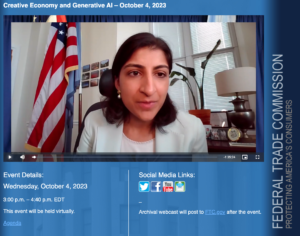
Former Federal Trade Commission Chair Lena Khan starts off an FTC roundtable web discussion on artificial intelligence and copyright.
Generative AI presents a unique set of opportunities and challenges to creative industries, said former FTC Commission chair Lena Khan in a roundtable discussion Oct. 3, 2023 (transcript here). One significant point, she noted: “All of the laws that already prohibit unfair methods of competition or collusion or discrimination or deception — all of those laws still entirely apply” (to AI).