
A war of words over digital media regulation
Two households, both alike in dignity … from ancient grudge break to new mutiny…” (Prologue, Romeo and Juliet)
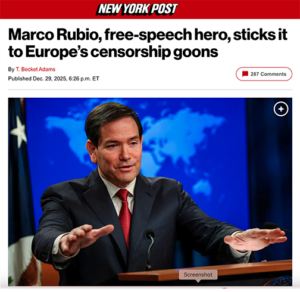
Pugnacious US approach to EU regulations is clear in this NY Post opinion article.
Since the end of WWII, the US and Europe have had very different approaches to censorship in certain areas, especially hate speech, personal privacy, and public health information.
Antisemitic rhetoric and Nazi symbols have been banned in Germany, France and other EU member nations for over 80 years. Hate speech, of course, was closely linked to the Holocaust and genocides in Rwanda and Bosnia in the 1990s. Hate speech also led to the assassination of a German politician in 2019.
In contrast, US takes a “marketplace of ideas” approach to extreme rhetoric, banning only speech that provokes imminent lawless action (under Brandenburg v Ohio, 1969). This is the “counter speech doctrine,” and the idea is that bad speech should be countered by good speech. (See Counterspeech at the MTSU Free Speech Encyclopedia). Of course, violence has followed hate speech in the US as well, but certainly not on a scale like Rwanda, Bosnia, or the Holocaust.
With the advent of instant international communications through the internet and web, and the democratization of the marketplace of ideas, laws in one region of the world have often come in conflict with laws in others. Finding routes to harmonization of conflicting laws is a major project for global diplomacy. Instead, the Trump administration in 2025-26 is taking a needlessly beligerent approach to its European allies and accusing then of Nazi style censorship. The Trump administration believes that global tech and social media companies should not regulated through the EU government.
========
The European Union enacted two new laws, the Digital Services Act (DSA) and the Digital Markets Act, in November 2022, to directly regulate hate speech and misinformation. The laws also guard against violations of individual privacy and corporate antitrust (anti-monopoly) laws.
The EU’s Digital Services Act protects users privacy rights and aims to regulate accountability, content moderation and platform transparency in the EU. Large platforms are required to allow independent researchers access to algorithm decisions while also allowing private individuals to legally contest information that the platforms may have about them. Claims about censorship involve content moderation of hate speech and other political speech that would not be illegal in the US.
The EU’s Digital Markets Act aims to make the digital economy fairer and more contestable. Large digital platforms providing core platform services (search engines, app stores, social media, messenger services) will have to comply with the do’s (i.e. obligations) and don’ts (i.e. prohibitions) listed in the DMA. The first DMA fine — against Twitter / X on Dec. 5, 2025 for 120 million euros — was in part for improperly assuring customers that its “blue check” is an actual check on the identity of the account holder.
Trump objections are changing the US – European alliance
One of the first things Donald Trump did when taking office Jan. 20, 2025 was to issue a presidential proclamation against censorship and calling for a Justice Dept. Investigation of the Biden administration’s First Amendment policies. https://www.whitehouse.gov/presidential-actions/2025/01/restoring-freedom-of-speech-and-ending-federal-censorship/
Trump also appointed Elon Musk, owner of Twitter / X, to a government advisory position. Musk and other tech billionaires were worried about EU’s DSA and DMA regulatory positions which they saw as censorship of European conservatives even though it is specifically aimed at hate speech, public health disinformation, and terms of service issues.
On Feb 14, vice president JD Vance spoke out at a security conference in Munich, Germany, against EU DSA regs that he said could “destroy democracy” and lead to a “Fourth Reich” in Germany. https://www.youtube.com/live/pCOsgfINdKg Vance also met with far-right political party Alternative for Germany (AfD) leaders who want Germany to get over its Holocaust guilt.
The reaction: “Vance Shocks Europe.”
A month later, Vance stuck a more conciliatory tone: “ I think — I mean this from the heart and as a friend — that there is a trade-off between policing the bounds of democratic speech and debate and losing the trust of our people. And we’re all going to draw the lines a little bit differently,” Vance said. “I’m fine if one country is going to draw those lines a little bit differently than the United States.”
Concern about EU “censorship” grows
The controversy over EU censorship — or, as the EU sees it, digital sovereignty — continued through most of 2025. One important development was a July 25 House Judiciary Committee report on “Foreign Censorship Threats,” which focused on the EU and disagreements about regulating online speech. ]
This report and Vance’s ongoing statements were widely contested by EU members who said that Vance’s remarks were “insulting” and “just empirically not true” and that they were not silencing minority opinions.
The controversy took a new turn on December 5, 2025, when Elon Musk’s social media company Twitter / X was fined 120 million euros ($140 million) by EU tech regulators in Brussels for breaking online content rules. This was the first fine under DSA landmark legislation. Musk replied “Bullshit” under a European Commission post about the fine. He also reposted several messages criticizing the decision and wrote: “Freedom of speech is the bedrock democracy. The only way to know what you are voting for.”
On Dec 23 the US State Department put travel bans on five EU citizens for being involved in this supposed “censorship.” According to CNN:
The Europeans, characterized by Secretary of State Marco Rubio as “radical” activists and “weaponized” nongovernmental organizations, fell afoul of a new visa policy announced in May to restrict the entry of foreigners deemed responsible for censorship of protected speech in the United States.
On Dec. 24, a federal judge in New York temporarily blocked the Trump administration from detaining a British researcher whom it accused of promoting the online censoring of American viewpoints.
MORE
From the EU perspective;
- “Hate Speech: Comparing the US and EU approaches.”
- “The EU has no place for hate.”
- “America as a digital narco state,” Paul Krugman
From the US perspective:
- Cato Institute, March 2025
- The Atlantic Council, August 15, 2025
- The Free Press
- Pug dog’s hitler salute
- House Judiciary Committee July 2025