
We need a special category for President Donald Trump’s libel suits because he has filed so many for so little reason. This litigation was unprecedented in US history.
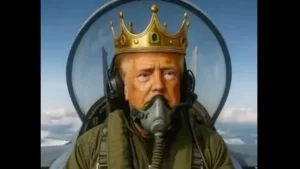
Trump posted this ai-generated video of himself with a crown to mock “No Kings” protesters in 2025.
The underlying theory in these lawsuits appears to be the archaic concept of lèse-majesté (defamation against the dignity of his majesty), also known as seditious libel.
This is why protests about Trump’s activities were often framed around the “No Kings” idea, and also the reason why Trump mocked them in a video he posted Oct. 19, 2025.
Background
Seditious libel prosecutions were relatively rare in the US after the John Peter Zenger case in 1735 and the short-lived Alien & Sedition Acts of 1798. Only in the WWI-era Sedition Act of 1917 were any significant numbers of people jailed by the federal government for protesting. As we have seen in Section 4, this was affirmed as a “clear and present danger” in the Schenck case (1919), incorporated in the Abrams case (1925), and challenged by a dissent in the Whitney case (1927). The Schenck standard was finally overturned in the Brandenburg v Ohio case (1969), which greatly narrowed the definition of criminal sedition to “imminent lawless action,” leaving open many avenues of criticism of government and leaders as perfectly legal under the First Amendment.
Only once has any other US president sued a newspaper for libel
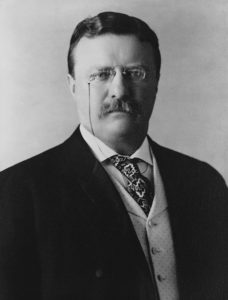
US president Teddy Roosevelt
Teddy Roosevelt sued the New York World newspaper and ordered federal attorneys to file criminal libel suits against newspapers all over the country on Dec. 15, 1908. A grand jury had brought charges against the World for criminal libel because the newspaper alleged that while serving as president, Roosevelt had approved corrupt payments to speed the sale of the Panama Canal from the French to the US government.
Roosevelt was a lame duck, and only two months away from stepping down as president. The announcement of the suit prompted laughter on the floor of the US Senate and resignations in US attorneys offices. The suit was considered to be far beneath the dignity of the office.
Informed of the lawsuit, World publisher Joseph Pulitzer famously responded: “He cannot muzzle the World.” (See Pulitzer’s Reply Dec. 16, 1908). According to Columbia University:
In addition to fighting for freedom of the press throughout the United States, Pulitzer fought what he considered Roosevelt’s attempts “to re-establish the principle of the odious Alien and Sedition laws and to create here the doctrine of lese-majesty.”
The US Supreme Court ruling in US v Press Publishing was relatively short, and simply sustained an objection by the defendants that “the court has no jurisdiction in this case, because there is no statute of the United States authorizing the prosecution.”
The decision in the 1911 case was (until recently) considered the “last gasp” of seditious libel prosecutions, and “a landmark, one of the substantial guarantees of the continued freedom of the press.” Given this history, no other sitting president since Roosevelt seriously considered filing libel suits. Even outright allegations of murder in 1994 did not tempt President Bill Clinton to wield the cudgel against critics like Jerry Falwell.
Which brings us to Donald Trump, the president who defied so many expectations in so many ways.
Trump 2025-26 lawsuits
JPMorgan Chase — Jan. 22, 2026 — Trump sued the bank and its CEO, Jamie Dimon, for “trade libel,” claiming they “debanked” him (closed his bank accounts) for political reasons.
British Broadcasting Corp — Dec. 15, 2025 — Donald Trump sued the BBC for $10 billion, accusing the news organization of a “defamatory … depiction of President Trump” simply because of the way a video of one of his speeches was edited. He also claimed it was an “attempt to interfere in and influence” the 2024 U.S. presidential election. The 33-page brief is essentially a litany of opinionated complaints without much of a legally grounded argument about defamation. There is only a half-hearted attempt to meet the Sullivan actual malice standard, for example (p 15). The main argument is that selective editing of a video of Trump’s speech on Jan. 6, 2021 gave the impression that he called for violent action in the hours before the violent takeover of the US Capitol by his followers. (This same impression was widely shared and, for example, led to his de-platforming on Facebook and Twitter on Jan. 8, 2021.) In January 2026, BBC asked a Florida state court to dismiss the suit.
ABC and CBS News — Dec. 14 2024 and July 1, 2025 — Trump also filed lawsuits against ABC News (which ABC settled for $15 million Dec. 14, 2024) and and CBS News’ “60 Minutes” (which CBS settled July 1, 2025 for $16 million). The settlements should be seen against the backdrop of proposed mergers by parent corporations that needed approval of the Trump administration’s Federal Trade Commission. The libel suits themselves would have been easily defeated by the news organizations, but their capitulations were called a “big fat bribe” by Late Night host Stephen Colbert (who was then fired by CBS)
Wall Street Journal — July 2025 — Trump sued after the newspaper published a story reporting on his ties to wealthy financier and convicted sex offender Jeffrey Epstein.
NY Times lawsuits — Sept. 15, 2025, Trump filed a $15 billion defamation lawsuit that targets four New York Times journalists over a book and three articles published just before the 2024 election. On Sept. 19, 2025 a Federal judge dismissed the lawsuit. A month later, Trump refiled the lawsuit.
Meta (Facebook) — January 2025 — FB settled a lawsuit brought by Trump for $25 million after allegations that Trump was unfairly de-platformed by the social media service.
Pulitzer Prize Committee — 2024 — The Russia suits (against the NY Times and Washington Post in 2020) were revived in a libel case Trump brought against the Pulitzer Prize Committee, which had awarded prizes to the Post and Times for the Russia articles. Trump complained that the Pulitzer committee turned down his demands to rescind the prizes. In July, 2024, the suit survived a motion to dismiss, a minor victory for Trump. In December, 2025, the Pulitzer committee filed discovery motions asking for Trump’s medical records.
New York Times –– January, 2024 — Another Trump libel suit against the New York Times and its coverage of his family’s wealth was dismissed by a New York court, and Trump was ordered to pay nearly $400,000 in legal costs.
CNN — In 2023, a judge also threw out his defamation lawsuit against CNN, in which he alleged the network had likened him to Adolf Hitler.
Twitter / X — 2022 — Case brought by Trump about unfair de-platforming was dismissed by US Supreme Court.
NY Times, Washington Post — 2020 — Trump lost a libel suit against the New York Times on Feb. 26, 2020, and lost a related suit against the Washington Post, on March 3, 2020. In the suits, Trump claimed that an opinion article about Trump’s relationship with Russian dictator Vladimir Putin involved a libelous assertion that there was a “quid pro quo” with the Russians in return for their help in the 2016 election. (The plaintiff’s petition can be read here.) This “quid pro quo” was described in an op-ed written by former New York Times editor Max Frankel and published March 27, 2019. In the op-ed, Frankel rejected small concerns about “collusion” with Russia in the Trump campaign. The much larger issue, he said, involved the relationship between Trump and Putin. Both of these suits were dismissed.
Trump’s previous libel suits
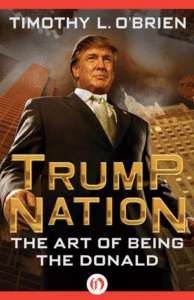 2005 — TrumpNation: The Art of Being the Donald was a 2005 biography of Donald Trump was the subject of a $5 billion lawsuit against author Timothy L. O’Brien. It was dismissed in 2009, and an appeals court affirmed the decision in 2011.
2010 — Trump University filed a libel suit against Tarla Makaeff, a former student, who initially sued to recover money shew paid to the private “university.” The case was dismissed in 2014 and Trump “U” was ordered to pay Makaeff’s legal costs.
2014 — Trump sued “Miss Pennsylvania,” a woman who alleged his Miss USA 2012 beauty pageant was rigged.Trump also sued the Chicago Tribune in 1984 for criticizing his taste in architecture — and lost. He sued a former student at the former Trump university for saying it’s not really a university — and lost. (Susan Seager at the Media Law Resource Center has details).
Trump v E. Jean Carroll One of Trump’s biggest losses in a libel suit involved columnist E. Jean Carroll. The suit was filed in 2019 after Trump was convicted in civil court of sexual assault and then, when he kept lying about the case, Carroll sued for libel in a second trial. On January 26, 2024, a jury deliberated for three hours and awarded Carroll $7.3 million in emotional damages, $11 million in reputation-related damages, and $65 million in punitive damages, totaling $83.3 million. The jury found Trump had committed sexual abuse and forcible touching, two of the three elements of Carroll’s battery claim.
And the question is …
Why does Trump file so many libel suites? These are political tactics, not serious lawsuits, and Trump certainly knows enough about libel to know that the suits are frivolous. ProPublica president Richard Tofel saw it this way:
“What is happening here is a cynical play to establish a talking point. Now, whenever the nation’s leading newspaper reveals some new abuse of power or malfeasance in office, Trump can point out he is suing the Times. Perhaps, he may hope, the Times news pages will even pull a punch or two to avoid being seen as a presidential adversary.” Tofel goes on to say “I hope and trust they will not.”
“Donald J. Trump is a libel bully,” explains Susan E. Seager in the Media Law Resource Center, who has kept count of Trump’s 4,000 plus lawsuits over 30 years.
Katie Fallow at the Knight First Amendment Institute at Columbia University said:
These shameful episodes illustrate two troubling trends … First, Trump has wielded the enormous power of the federal bureaucracy, including the power of the purse and regulatory oversight of businesses, to silence critics and control the viewpoints of private speakers. These actions fly in the face of the fundamental First Amendment principle that the government should not be permitted to use its power to censor viewpoints or distort public discourse.
Second, far too often these speakers have folded in the face of the Trump administration’s threats rather than use the strong protections of the First Amendment to vindicate their right to free speech. The First Amendment, as powerful as it is, can only be a shield to those who are willing to use it as one. It is hard to muster much sympathy for corporations that have chosen to capitulate needlessly. But the real loser here is the ability of the press and other speakers to criticize powerful figures and expose wrongdoing by government and corporate entities.
Trump’s overall plan was originally to dismantle libel laws and make it easier to sue media organizations for unfavorable coverage. But only the US Supreme Court could change the law of libel, and decisions in cases during the 2023 – 2025 period, showed that a majority wanted to leave the bedrock Sullivan standard in place.
It’s not possible for Trump himself to legally change libel law. According to First Amendment Watch:
“There is little that the President can actually do to change the libel laws. There is no federal law on libel. State laws control libel, and all such laws are subject to stringent First Amendment protections for the press and other speakers that the Supreme Court has imposed through cases such as the landmark New York Times v. Sullivan decision in 1964. “
Trump’s immature partisan attacks on political rivals
It should be noted that these highly unusual presidential libel suits are fully in character as expressions of a crude and immature personality that also include: attacks on the press as “enemies of the people;” his Nov. 28 database that (in the words of his press release) “drop(s) a flamethrower on the Fake News Media;” his attacks on comedians like Seth Myers, Stephen Colbert, Jimmy Kimmel and musicians like Taylor Swift and Snoop Dogg. These originate in a personality that seems (to most Americans) unsuited to the serious business of democratic governance.
One of the worst examples of partisan immaturity in 2025 occurred on Oct. 19 when Trump posted an ai-generated video in which flies a jet in order to dump sewage on the heads of No Kings protesters, including liberal activist Harry Sisson. (See video on this page).
MORE
- First Amendment Watch has a special category for Donald Trump’s defamation lawsuits.
- Trump’s war on the media – Air Mail. Nov 22, 2025