

Brendan “hard way” Carr, FCC chair, 2025 – 26.
Donald Trump’s long string of petty grievances against the mainstream press and traditional broadcasters has led to an unprecedented reaction — an attempt to twist the news on behalf of his partisan political viewpoints.
Led by FCC chairman Brendan Carr, the pressure began as soon as Trump was re-elected and took office in January 2026. It has continued throughout his presidency so far. One of the most interesting moments was in September, 2025, when Carr said: “We can do this [censorship] the easy way or the hard way.” (See the video from Sept 17, 2025).
However, many of Carr and Trump’s creative legal maneuvers will not likely be upheld when eventually challenged in court, if a 9-0 Supreme Court decision in NRA v Vullo (2024) or longstanding First Amendment precedent is any guide at all.
——–
March 14 — FCC chair Brendan Carr threatens to revoke broadcast licenses over (supposedly) incorrect news items. This followed a Trump social media post March 14 in which the president irrationally claimed that damage reports from one minor skirmish were deliberately distorted. “Their terrible reporting is the exact opposite of the actual facts!” Trump wrote. “They are truly sick and demented people that have no idea the damage they cause the United States of America.”
According to the NY Times: “Democratic lawmakers and free-speech watchdogs were quick to condemn Mr. Carr’s threat as a violation of the First Amendment. On social media, Senator Elizabeth Warren of Massachusetts called it “straight out of the authoritarian playbook,” while Senator Mark Kelly of Arizona said that “when our nation is at war, it is critical that the press is free to report without government interference.”
Feb 17, 2026 — An interview with Texas democratic candidate for senate, James Talarico, was blocked from the CBS broadcast of the Tonight Show with Stephen Colbert under (supposedly) the Equal Time Rule.
— 2025 —
Oct 15 – Nearly all US and foreign broadcast media refuse to accept a Pentagon censorship policy imposed by Secretary of Defense Pete Hegseth.
Sept. 17 – ABC network cancels Jimmy Kimmel’s late-night show at FCC Chairman Brendan Carr’s request. Kimmel returned Sept. 23 with a moving defense of free speech.
Sept. 19 – Judges tosses Trump’s defamation lawsuit against New York Times. Trump refiles Oct 16. Very unlikely to prevail.
Aug. 25 –– Trump calls for FCC to revoke broadcast network licenses (even though the networks themselves are not licensed).
July 18 – Trump sues The Wall Street Journal over Jeffrey Epstein revelations.
July 18 – Paramount / CBS cancels Stephen Colbert’s late night show after he calls the Trump defamation settlement “a big fat bribe.”
July 2 — Paramount / CBS agrees to pay $16 million to Trump in a defamation settlement that would have been easy to win for its supposedly biased editing of an interview with Trump political rival Kamala Harris. In the background is a proposed merger between Paramount and Skydance Media.
May 1 – Trump and Congress slash all funding for PBS and NPR
April 25 — Justice Dept. will now investigate leaks and subpoena news reporters.
Feb. 12 – Trump removes the AP from White House press pool for refusing to officially rename the “Gulf of Mexico” the “Gulf of America” in the AP Stylebook. The controversy is soon forgotten and even Trump mapmakers omit the “Gulf of America” designation.
December 2024 – Disney / ABC settles defamation lawsuit that would have been easy to win. In the background is a Paramount–Warner Bros. Discovery merger with Disney / ABC.
NRA v Vullo (2024) is one case that will have an effect on how these fights are eventually seen. Justice Sotomayor wrote the opinion for the unanimous court:
“Six decades ago, this Court held that a government entity’s “threat of invoking legal sanctions and other means of coercion” against a third party “to achieve the suppression” of disfavored speech violates the First Amendment. Today, the Court reaffirms what it said then: Government officials cannot attempt to coerce private parties in order to punish or suppress views that the government disfavors.
“Petitioner National Rifle Association (NRA) plausibly alleges that respondent Maria Vullo did just that,” she wrote. “As superintendent of the New York Department of Financial Services, Vullo allegedly pressured regulated entities to help her stifle the NRA’s pro-gun advocacy by threatening enforcement actions against those entities that refused to disassociate from the NRA and other gun-promotion advocacy groups. Those allegations, if true, state a First Amendment claim.”
Indecency and Obscenity
The Federal Communications Commission prohibits the broadcasting of obscene, indecent or profane words or images. It defines these terms in a consumers guide in this way:
- Obscene content does not have protection by the First Amendment. For content to be ruled obscene, it must meet a three-pronged test established by the Supreme Court: It must appeal to an average person’s prurient interest; depict or describe sexual conduct in a “patently offensive” way; and, taken as a whole, lack serious literary, artistic, political or scientific value.
- Indecent content portrays sexual or excretory organs or activities in a way that does not meet the three-prong test for obscenity.
- Profane content includes “grossly offensive” language that is considered a public nuisance.
While some content in these categories is protected under the First Amendment, it may still be objectionable in the presence of children, or in open public situations, or in over-the-air broadcasting.*
An historical controversy over radio indecency
 One of the first controversies over indecency in radio was the “Adam and Eve in the Garden of Eden‘ skit on the Chase & Sanborn Hour, Dec. 12, 1937. Don Ameci and Mae West are in the Garden of Eden, and West is getting bored.
Don Ameci: What do you want, trouble?
Mae West: Listen, if trouble means something that makes you catch your breath, if trouble means something that makes your blood run through you veins like seltzer water, mmmm, Adam, my man … give me trouble.
The Garden of Eden sketch prompted the FCC to issue a “stern reprimand” for violating “the ethics of decency.” The agency began considering how to deal more effectively with content on the radio networks – not just allowing or taking away station licenses, but reaching more into the core of the program development process. One effective tool was the National Association of Broadcasters Code of Ethics — an approach that allowed an industry to claim it was “self-regulating” rather than being censored.
Similarly, in re: WDKD Palmetto Broadcasting Co. 33 FCC 265, 1961 — The FCC reprimanded a South Carolina broadcaster for telling raunchy stories and saying “let it all hang out” on occasion. The FCC argued that broadcast media are unique. Radio and television were accessible to everyone “at the flick of a switch to young and old alike, to the sensitive and the indifferent, to the sophisticated and the credulous… ” And so the commission saw a duty to protect “those of highly developed sensibilities” from indecent language.
For years, the courts upheld the FCC’s idea that heavy handed regulation of obscenity and indecency was protecting the most susceptible members of society. Then came the Pacifica case:
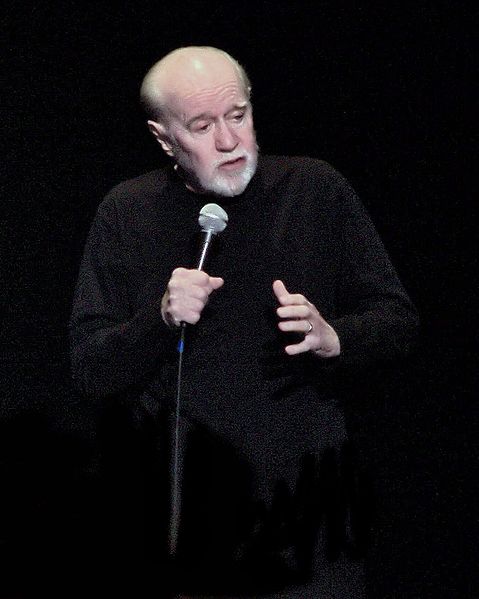
George Carlin
** FCC v. Pacifica Foundation, 1978, The court held that the FCC could create time, place and manner restrictions for indecent language, but not broad restrictions. The case involved George Carlin’s “Seven Dirty Words” monologue. The effect of the Pacifica case was to create a new time, place and manner restriction for adult-0riented content by setting aside the 10 pm to 6 am slot as a “safe harbor” for indecent material, since there would probably be no children in the listening audience.
1980s – 1990s — Over time, FCC standards slipped, but in 1987, FCC tried to re-regulate obscenity on the air, especially in songs (Makin’ Bacon), a play (The Jerker) and “shock” radio (Howard Stern). The FCC faced typical difficulties in defining indecency. They settled on:
“Language or material that depicts or describes, in terms patently offensive as measured by contemporary community standards for the broadcast medium, sexual or excretory activities or organs.” This, of course, is very similar to the language in Miller v California.
Action for Children’s Television v. FCC, 1995 — Following the 1980s crack down on indecency, the court in three progressive cases overturned FCC’s round the clock ban on indecency and returned to concept of a “safe harbor” for indecent programming from 10 pm to 6 am. Note, this doesn’t apply to cable networks, just over the air broadcasting.
FCC and the fleeting indecency cases of the 2000s …
2001 — FCC issues new regulations on indecency and obscenity — Complete with examples of indecency such as Howard Stern monologues, “I’m Not Your Puppet” Rap Song and “Uterus guy” rap. All in all, a very unusual government document. Here’s a summary.
2002 — – Billboard Music Awards, Cher gives classic response to critics: “I’ve had unbelievable support in my life, and I’ve worked really hard. I’ve had great people to work with. Oh, yeah, you know what? I’ve also had critics for the last 40 years saying that I was on my way out every year. Right. So fuck ‘em. I still have a job and they don’t.”
2003– Billboard Music Awards, Nicole Richie asks: ” Have you ever tried to get cow shit out of a Prada purse? It’s not so fucking simple.”
2004 — Super Bowl “wardrobe malfunction” involved a very brief glimpse of Janet Jackson’s breasts during a halftime show, leads to CBS v. FCC, 2011 — (Wardrobe malfunction case) A lower federal appeals court (3rd district) finds that the FCC improperly imposed a penalty on CBS for violating a previously unannounced policy. This case started in 2008, was appealed to the Supreme Court, and sent back to the 3rd district.
2004 — FCC prohibits “single uses of vulgar words” (fleeting expletives)
2005 — Congress approved increasing fines for indecency from $27,500 to $275,000 per incident. Many were gratified, but media professionals felt they had been singled out by the “ministry of culture” at the FCC. Twelve major violations that year resulted in $8 million in fines. Lawsuits ensue.
** Federal Communications Commission v. Fox Television Stations
2009 — The US Supreme Court upholds fine by the FCC against Fox network for off the cuff indecent remarks during the 2002 and 2003 Billboard Music Awards. The court said the FCC was not being arbitrary or capricious, but it did not review the case for First Amendment constitutionality.
2010 — A lower federal appeals court (2nd district) performs the constitutional review and says that the FCC’s rules on indecency are vague and violate the First Amendment. Fleeting explitives or wardrobe malfunctions should not lead to massive multi-million dollar fines. The lower court also said that it was possible that some construction of rules would be constitutional.
2012 — In an 8-0 decision the Supreme Court ruled that because the regulations at the time did not cover “fleeting expletives” (the regulations have since been amended to that end), the fines issues were invalidated as “unconstitutionally vague”. However, the Court also upheld the FCC’s authority to regulate broadcast television licenses without violating the First Amendment because it is doing so on behalf of the public interest, reaffirming FCC v. Pacifica (438 US 726, 1978).
Further reading
Abolish the FCC, American Conservative, Sept. 23, 2025. “President Donald Trump has displayed an exceptional ability to combine the separate civil liberties abuses of his predecessors into a more comprehensive toxic brew. The latest example involved the ABC television network’s decision to oust late-night host Jimmy Kimmel for insensitive, partisan remarks about the assassination of conservative activist Charlie Kirk. If ABC’s management had made that decision without pressure from the government, there would be no valid First Amendment issue involved…”
WDBJ (Roanoke) and the FCC, March 2015 — The FCC imposed a fine of $325,000 after WDBJ inadvertently aired obscene materials in 2012.
Also see the FCC frequently asked questions page about broadcast indecency.
An FCC guidance document with grossly explicit examples of profanity and indecency has apparently been deleted from the .gov pages, but is reproduced here. (password protected)
FURTHER READING
Meanwhile, First Amendment Watch is keeping score on Trump legal fights with news organizations.