
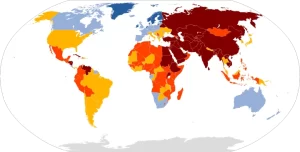
RSF 2025 Press Freedom Index
In the United States of America, the legal guarantee of freedom of expression is found in the First Amendment to the Constitution.
It has six major clauses; two concerning religion, and one each in the areas of speech, press, assembly and petition:
Congress shall make no law respecting an establishment of religion, or prohibiting the free exercise thereof; or abridging the freedom of speech, or of the press; or the right of the people peaceably to assemble, and to petition the government for a redress of grievances.
These six principles of freedom are just as important now as they were when the states ratified the First Amendment in 1791.
Although details of the First Amendment have been subject to some interpretation, the basic principles and court decisions are “blackletter law” — that is, they are so clear and so well supported by a string of important cases that they are beyond dispute. The most important among these cases is New York Times v Sullivan, a 1964 case in which the Supreme Court said in its unanimous opinion:
We [have] … a profound national commitment to the principle that debate on public issues should be uninhibited, robust, and wide-open, and that it may well include vehement, caustic, and sometimes unpleasantly sharp attacks on government and public officials.”. — New York Times v Sullivan
But if, as the First Amendment says, Congress shall make no law, how are differences to be resolved? How do we balance rights under the US Constitution?
The answer has been that the federal court system serves as the primary interpreter of constitutional law. Congress, the executive branch, and state courts have a secondary role. This means that decisions of the federal courts (especially the US Supreme Court) are the primary resources in the study of Constitutional law.
For example, if someone accuses a journalist or news organization of libel (defamation), the first point of reference will be similar cases already decided by the US Supreme Court. So we look for the most significant libel case that is still “controlling.” For libel, this would be the NY Times v Sullivan case and the subsequent cases that refined the “Sullivan standard.” (We’ll learn more about this in the section on libel in this course).
Where human rights are respected
• Many other countries are also committed to freedom of religion, speech and press, and many have their own foundational human rights documents and guarantees.
 The most significant international document is the Universal Declaration of Human Rights. Article 19:
Everyone has the right to freedom of opinion and expression; this right includes freedom to hold opinions without interference and to seek, receive and impart information and ideas through any media and regardless of frontiers.
And Article 18 says: Everyone has the right to freedom of thought, conscience and religion; this right includes freedom to change his religion or belief, and freedom, either alone or in community with others and in public or private, to manifest his religion or belief in teaching, practice, worship and observance.
 The European Convention for the Protection of Human Rights and Fundamental Freedoms, Article 10, is also very significant:
Everyone has the right to freedom of expression. This right shall include freedom to hold opinions and to receive and impart information and ideas without interference by public authority and regardless of frontiers…
African Charter on Human and Peoples’ Rights
.. include the right to freedom from discrimination (Article 2 and 18(3)), equality (Article 3), life and personal integrity (Article 4), dignity (Article 5), freedom from slavery (Article 5), freedom from cruel, inhuman or degrading treatment or punishment (Article 5), rights to due process concerning arrest and detention (Article 6), the right to a fair trial (Article 7 and 25), freedom of religion (Article 8), freedom of information and expression (Article 9), freedom of association (Article 10), freedom of assembly (Article 11), freedom of movement (Article 12), freedom to political participation (Article 13), the right to property (Article 14), and the right to resist (Article 20).
The Inter-American Human Rights System
… has played a critical role in rolling back the vestiges of authoritarianism in Latin American legal codes and thus consolidating the transition to democratic forms of government.
The Canadian Charter of Rights and Freedoms
Protects freedom of expression and the right to equality …
… provides for freedom of speech and of the press. In theory, an independent press, an effective judiciary, and a functioning democratic political system combine to ensure freedom of speech and of the press.
Where human rights are not respected
• Not every country respects human rights. While guarantees of free religion, speech, and press are the foundation of international law, they are not accepted in some countries.
Two non-governmental organizations that measure respect for free speech and press are Reporters Without Borders and Freedom House. According to the RSF press freedom index, the US has only a “satisfactory” rating, while the World Press Freedom report by Freedom House, gives the US has a top rating.
This is in sharp contrast to the “very serious” situation in Russia, China, Saudi Arabia, and other countries, where the press is rated “not free” in the Reporters Without Borders world press freedom index.
In China, the basic idea of freedom of speech is endorsed in its Regulations on the Administration of Publishing (2001.12.25) but within very strict limits.
The people’s government at each level shall guarantee the citizens to exercise the right of freedom of press in accordance with the law.
Any citizen must, when exercising the right of freedom of press, abide by the Constitution and laws, and must not object (to) the basic principles determined in the Constitution or damage the interests of the State, the society or the collective, or the lawful freedoms and rights of other citizens.
This is why Chinese dissident Liu Xiaobo, who won the 2010 Nobel Peace Prize, died in 2017 after spending years in country’s jails. This is why Jimmy Lai publisher of Hong Kong’s Apple Daily, was convicted of treason in December, 2025, and was expected to be sentenced to life in jail.
Chinese authorities have jailed more than 1,500 political other prisoners since 2019 in Hong Kong which was once a thriving democracy under the “one China, two systems” policy. That was finally crushed in 2023.
Saudi Arabia is another example of an absolute dictatorship in constant violation of the UN Declaration of Human Rights. The international rights group Amnesty International reports that the Saudis periodically stage mass executions of dissidents following trials that are grossly unfair to defendants. Any criticism of the country, its policies, its rulers or its traditions can lead to torture or execution — a stand reaffirmed by a “Royal Decree“ April, 2011. Meanwhile, dissidents outside the country are routinely kidnapped and assassinated. (See BBC’s “Saudi Arabia’s Missing Princes.” (Aug. 17, 2017) and coverage of the assassination of Jamal Khashoggi in October 2018). In August, 2024, Saudi-US citizen Abdulaziz al-Muzaini, creator of the Masameer animated cartoon for Netflix, was sentenced to 13 years in prison on trumped- up charges.
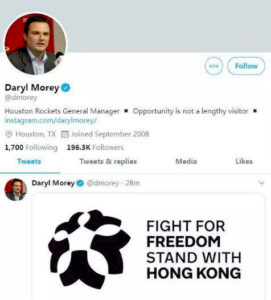
MONEY CANT BUY EVERYTHING: In October, 2019, Houston Rockets manager Daryl Morey tweeted in support of Hong Kong freedom protesters. The tweet may have cost the NBA billions of dollars. But what about the greater cost if free speech is repressed in the US as it is in China? And why do American golfers and other athletes get a free pass when they travel to Saudi Arabia? The controversy illustrates the increasingly global nature of free speech issues.
Russia — Although the Russian constitution has an article expressly prohibiting censorship, in reality censorship is a constant factor in the life of the Russian media, according to the US-based Wilson Center. In addition to loss of employment and possible prison sentences, a long list of Russian journalists have been assassinated. One example: Russian dissident Alexei Navalny produced a set of videos attacking the “incessant marathon of disgraceful propaganda, lies, and censorship” that was found on Russian television. One of Navalny’s videos gave a tour of “Putin’s palace,” which he dubbed “the world’s largest bribe” (Ling, 2024). Navalny’s death in a Russian prison in February 2024 was followed with protests from human rights groups and Western governments. In July, 2025, the Russian parliament approved a bill criminalizing online searches for “extremist” information, including Navalny and anything relating to LGBTQ information.
Belarus — A satellite state of Russia, Belarus is notoriously repressive. A Washington Post article July 9, 2022, notes: “Danuta Perednya was an honors student at Mogilev State University in Belarus when Russia began a military onslaught against Ukraine. On Feb. 27, just days after the invasion, she reposted a text in an online chatroom that harshly criticized Presidents Alexander Lukashenko of Belarus and Vladimir Putin of Russia for unleashing the war… She was arrested and … sentenced to 6½ years in a penal colony — for simply expressing her views.” Belarus is “a dictatorship using terror and coercion against its own people to smother free speech and association” according to the Post.
Human Rights Non-Governmental organizations
- Amnesty International: A global movement campaigning to end human rights abuses, with millions of members in over 150 countries.
- Freedom House: A non-profit based in Washington DC, partially funded by the US government
- Human Rights Watch (HRW): Investigates and exposes human rights violations, holding abusers accountable.
- International Federation for Human Rights (FIDH): A federation of 184 organizations working on civil, political, economic, social, and cultural rights.
- Physicians for Human Rights (PHR): Uses medicine and science to expose human rights violations, particularly in conflict zones.
- International Rescue Committee (IRC): Provides aid and advocates for people affected by humanitarian crises.
- Reporters Committee for Freedom of the Press
- Reporters Without Borders (RSF): Focuses on freedom of the press and expression.
- International Crisis Group (ICG): Works to prevent wars and shape policies for a more peaceful world.
- Survival International: Campaigns for the rights of indigenous peoples.
- International Committee of the Red Cross (ICRC): Protects victims of armed conflict and provides humanitarian aid.
- Committee on Human Rights, US National Academies of Engineering, Medicine and Science.
MORE
- Twenty-five human rights organizations
- Key principles of Human Rights – Media Defense – List of papers on international human rights
- Censorship in China – Council on Foreign Relations
- How Saudi Arabia Gets Away With Murder – Council on Foreign Relations
- Reporters without Borders – French-based worldwide human rights organization