Resources
- Society of Professional Journalists (SPJ)
- Columbia Journalism Review
- NPR reporters Center training
- BBC reporter training
- SPJ SMACK support site for college media
- Student Press Law Center
- Grammarly blog
- Media law and ethics -- RU COMS 400 class pages.
- Revolutions in Communication: Media history from Gutenberg to the digital age (London: Bloomsbury, 2015) -- also RU COMS 300 class pages.
- Virginia Press Association
- Photojournalism and visual communication -- RU COMS 226 class pages.
- Society of Professional Journalists (SPJ)
Media jobs
A poet’s view
Posted in Uncategorized
New NC law represses campus speech
North Carolina is considering (in April, 2016) a law that would harshly punish anyone who disrupts campus activities. Although designated a “free speech” law, the intent of the law appears to be the opposite of its name.
Posted in Uncategorized
Solutions journalism course
Poynter’s News University, in partnership with the Solutions Journalism Network, is offering the self-directed course “Solutions Journalism in Every Newsroom.”
Participants will learn how to define solutions journalism; identify and vet solutions journalism story ideas; structure a solutions story; write or produce solutions stories; and incorporate solutions journalism into daily workflow and beat reporting.
This course is in beta phase. As a bonus, participants who complete a survey at the end of the course will receive a free NewsU webinar.
Registration is ongoing. The course can be taken at any time.
For more information, click here.
(From International Journalism network )
Posted in Uncategorized
Undercover reporting

Nelly Bly, undercover reporter for Pulitzer’s World newspaper, went undercover for “Ten Days in a Mad House”
When is it ethically and legally justifiable to go undercover to report a public interest story? Good question. Brooke Kroeger’s book and project, Undercover Reporting: The Truth About Deception, looks at the historical answers to that question.
On The Media interviewed Kroeger about the issue.
Posted in Uncategorized
“New Pills to Purge Melancholy . . .”
To sift the news, extract, refine,
We’ll start, they say, with nine, nine, nine,
The Fleet St. muttered: news comes late
Let’s get them down to eight, eight, eight.
The Treasury mildly swore to heaven
They’d soon reduce each eight to seven.
The Commons cried: confound their tricks,
They can’t need more than six, six, six,
And if they’re keen, alert, alive,
They ought to do with five, five, five,
The public shrieked: more news, much more,
Reduce your staff to four, four, four,
Lord Camrose spoke: leave this to me,
I’ll run it all on three, three, three.
The pundits wrote: Now this won’t do,
The right amount is two, two, two.
Their task was hardly yet begun
When lo, they dropped to one, one, one,
Before they’d done one half they ought
They quietly dwindled into nought.
Anonymous Ministry of Information official, 1939.
From Nicholas Cull’s “Selling War,” 1995, Oxford U Press.

Posted in Uncategorized
Journalism, n.

Journalism is fun! Or at least, that’s the premise of this journalism kit being sold in department stores.
OK, so journalism isn’t always about serious stuff. Sometimes it involves glittler, gemstones and bottles of Elmers glue.
The “Learn to be a Journalist” kit is apparently being sold at K-Mart. Prof. Kovarik is hoping to find one sometime soon and refresh his Glitter 101 skills.
Etymologically, the word journalism is French in origin: “journalisme, “ which, according to the Oxford English Dictionary, was found as early as 1781 in a French publication.
The actual definition is this:
1. a. The occupation or profession of a journalist; journalistic writing; the public journals collectively.
Posted in Uncategorized
About journalism

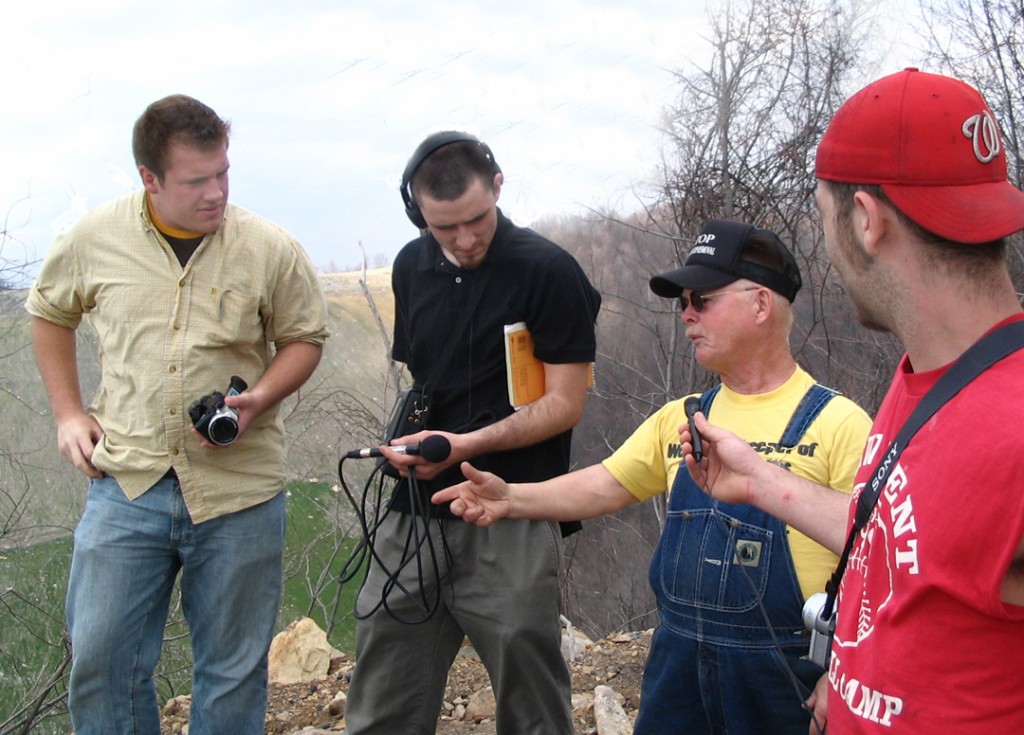
The late Larry Gibson, the “Lorax” of Appalachia, being interviewed by RU students at a mountaintop removal mining site.
Journalism is needed like never before. At a time when the world seems perched on the ledge of self-destruction, we need people who can act independently, serve the public interest, and search for the truth.
Journalists are among the few professionals whose duty is to serve the public interest and who are guided by professional ethics and personal conscience.
There’s never been a better time to go into journalism. Sure, the field is crowded, the obvious opportunities are limited, and many publishers are in trouble. But there is still a demand for information. People need to understand the world around them, and this is, after all, the information age. There are lots of ways to make a living in the news business. Continue reading
Comments Off on About journalism
Posted in Uncategorized